
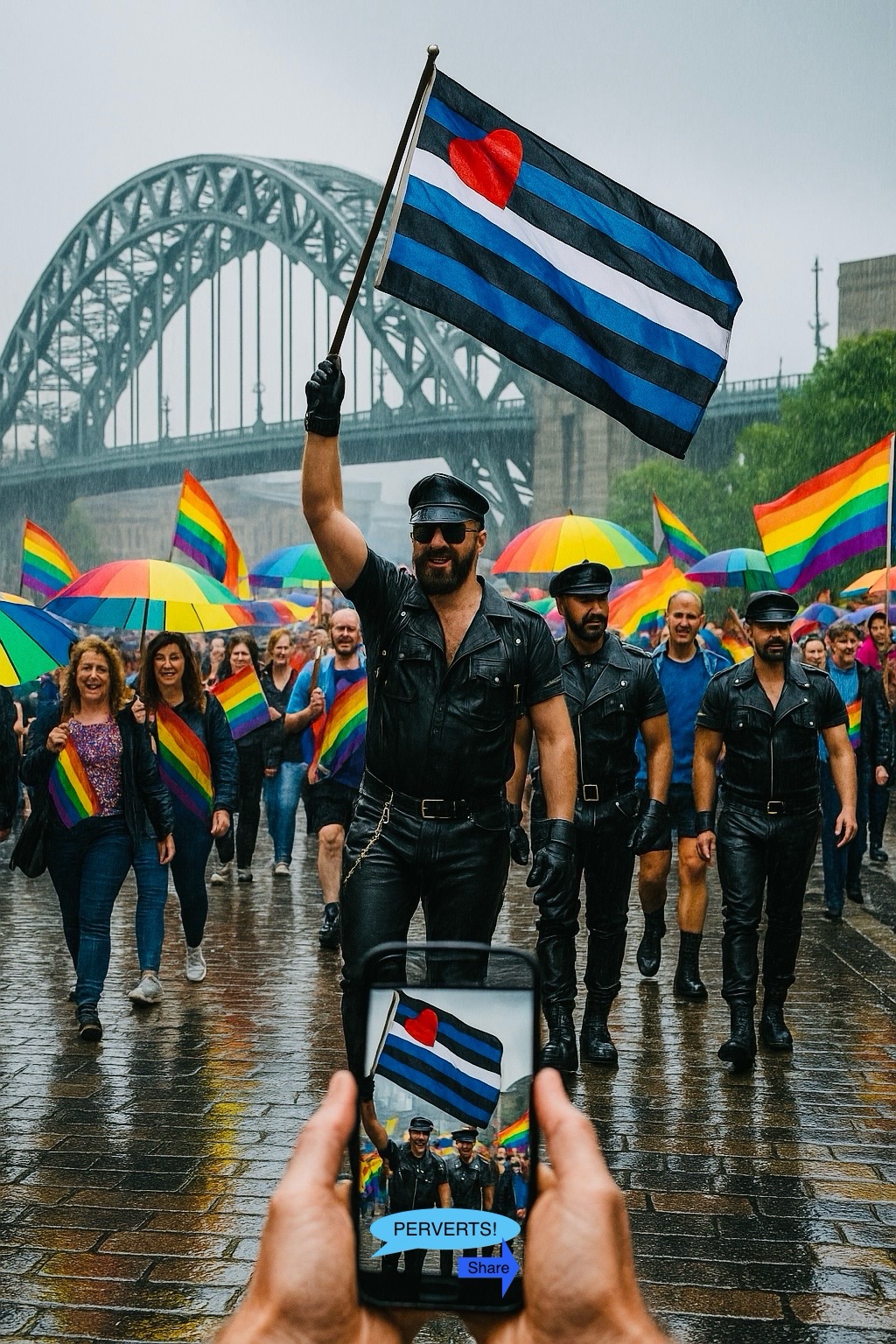
There are years when nothing happens, and then there are weekends when everything does. Northern Pride 2025 was one of those weekends. I walked through the streets of Newcastle in full leather, openly, unapologetically, joyfully. Once, the thought of doing that in this city would have been unthinkable. Now this Sunday, I was asked by a straight couple; curiously, not cruelly, whether I was dressed this way to provoke lesbians. They smiled. We laughed. But I was left wondering: had they read the comments under the Chronicle’s Facebook post? Had they seen what I had seen? Comments that echoed a recent clash I had with a fellow queer woman who insisted that leather and fetishwear have no place at Pride. That kind of sanitisation, whether coming from outside or within, won’t protect us. I take up that fight directly in No, Pride Hasn’t Been Hijacked, It’s Just Not Yours to Sanitise!, because if our liberation demands conformity, it’s not liberation at all.
Because online, the atmosphere was very different. In the virtual spaces that mediate our civic life, where comment sections masquerade as public squares, I found not curiosity but contempt. And I found myself asking a question that has echoed through much of my adult life: why do I still have to speak up?
This is not the first time I’ve written about visibility, resistance, or the subtle violence of being perceived. On Blufbear.com, I’ve written about queer shame, about the scars of growing up under a panopticon of heteronormativity. But this year, as I sat reading the responses to a local news post celebrating Pride, I felt something deeper, harder. Not despair. Not even surprise. But a kind of brittle resolve.
The Chronicle’s “What’s On NorthEast” post about Pride unleashed what can only be described as a digital onslaught of homophobia, transphobia, and moral panic. Slurs went unmoderated. Pride was likened to a “pedo parade.” Trans people were branded mentally ill. A joyful soul in a pup hood was pilloried as a pervert. Commenters dredged up the same tired lines: “When’s straight pride?” “It used to be fun until the politics took over.” “Keep it private.” Pride, in their telling, was no longer a celebration but a threat, a narcissistic cult of perversion parading itself through the streets.
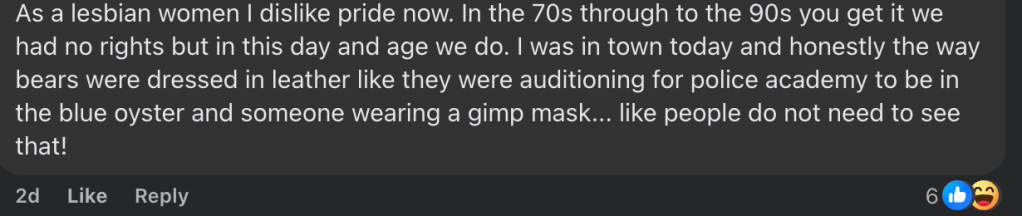
What struck me wasn’t the originality, there was none, but the sheer volume and brazenness of the hate. And the silence of those who hosted it. The Chronicle did not moderate. Meta did not step in. The post remained, festering with bigotry, its engagement metrics soaring.
This wasn’t an anomaly. The incentives are perverse but predictable: outrage drives clicks, and clicks drive profit. For local media platforms struggling for survival, Pride becomes easy bait. Post a rainbow banner, stir the pot, and let the comments section burn. Meanwhile, social media platforms like Facebook quietly reap the rewards of division. The more people argue, the more time they spend on-site. Rage is not just permitted; it is monetised.
And that is the paradox we face. I write this on a blog that lives and dies by visibility, one that, like so many others, depends on engagement to amplify its voice. I rely on the same algorithms I critique, hoping they carry these words further than my own reach ever could. In speaking out against the commodification of queer identity, I must participate in it. That tension is not lost on me.
These platforms, for all their pretence of neutrality, are not passive conduits of public opinion. They shape discourse. They set the emotional tone. And they have become, in effect, battlegrounds where progress can be made… and undone.
I’ve seen this pattern before. For every inch we gain in public space, we risk a backlash in digital space. It’s a kind of historical seesaw: progress followed by retrenchment, visibility followed by vilification. There’s a philosophical framework for this, too. Karl Popper warned in The Open Society and Its Enemies that unlimited tolerance leads to the demise of tolerance. If a society tolerates the intolerant without restraint, the intolerant will destroy that very openness.
Popper argued that we must be willing to suppress intolerance, peacefully, intellectually, but decisively, lest it take root. But where I part ways with him is in the simplicity of his prescription. Because in the digital age, it’s not just that intolerance exists. It’s that it has found a home, algorithmically boosted, commercially viable, and effectively ungoverned.

And so the question isn’t just should we suppress intolerance. It’s how, in an ecosystem designed to thrive on its presence.
That’s why Newcastle City Council’s social media presence stood out in stark relief. The same volume of bile poured in under their Pride post, but their replies were different. Polite, firm, informed. No derision, no censorship, just facts, patiently repeated. They weren’t cowed by the volume of hate. They didn’t retreat. They stayed visible. And they modelled what civic resilience can look like in the age of algorithmic incitement.
That matters. Because even for someone like me, who has written about these issues, marched, protested, partied, there are moments when the noise can feel deafening. When it would be easier to retreat into our own curated bubbles. To tune it out.
But Pride reminds us why we can’t.
The weekend itself was euphoric. It began with an enthusiastic leather social hosted by the Newcastle Leathermen—a space I couldn’t have imagined as a lonely university student years ago. The Leathermen representation was resplendent in a rain-soaked (wipe-clean) but jubilant march, the beat of Drumdin drummers lifting us above the drizzle. Their pulse turned wet pavements into a stage, every beat a reminder that we march not just to be seen, but to be heard. We climaxed at DILF, an unapologetically fetish-forward night of queer connection. And we followed with a gentle, affirming Sunday brunch, where leather met laughter in the morning light. And those not at work represented at the candlelight vigil to honour those we’ve lost, and those whose bravery brought us to this moment of visibility and joy.

That joy was real. It was earned. It was collective.
But that joy exists because people before us refused to shut up. Because they risked ridicule, violence, and marginalisation to carve out space for the rest of us. And because we continue to show up, not just when it’s easy, but when it’s loud, messy, and painful.
So let this essay be my thank you. To those who moderate the hate instead of monetising it. To the Newcastle Leathermen. To those who show up in leather, in drag, in defiance. To those who don’t just post a rainbow once a year but live their values in the hard moments.
And let it be my call to action. For a better media ecology. For platforms that value community over conflict. For a Pride that doesn’t shy away from politics, but embraces its roots as resistance.
We live in an age of backlash, but also of possibility. The road ahead is uncertain, and the slope is slippery. But if Northern Pride 2025 has shown us anything, it’s that queer joy is still powerful. Still disruptive. Still necessary.
And if I have to keep speaking up to protect that joy, so be it.
Let’s keep marching. Let’s keep resisting. Let’s be outspoken.
Let’s keep showing up: for each other, for those not yet out, for those who can’t.
Let’s keep wearing what they say we shouldn’t: leather, pup masks, gimp hoods, because we know that freedom means nothing if it must be sanitised to be acceptable.
Let’s remind them that queer liberation was never meant to be palatable and we’re not dressing down just to make bigots comfortable.
One response to “Facebook Hate Won’t Rain on My Parade: Northern Pride 2025, Leather Loathing Lesbians, and Lashings of Leathermen”


 BlufBear
Leave a reply to peaceclassybb1f4a1d88 Cancel reply