
There are few things more revealing than watching a community built around self-invention become anxious about the “wrong kind” of self-invention.
I should admit, before going further, that leather contests have never quite been my world, not because I do not want them to be, but because I have never felt free enough to step fully into them. I would love to be more involved. I would love to have the time, confidence and public safety to stand closer to that stage, to learn properly, serve properly, and participate without fear. But I also work in a profession that would, I suspect, crucify me if the wrong photograph, the wrong sash, the wrong leather context, or the wrong set of assumptions escaped into the wrong hands. We speak easily about inclusion, authenticity and bringing one’s whole self to work, but some selves are still tolerated only while they remain discreet. So I have lived, as many do, at the edge of things: drawn to leather, shaped by it, grateful for it, but cautious about visibility. Not because I lack commitment, but because exposure has consequences.
That has made titleholders matter to me in a way I did not expect. Over the years, meeting people such as Jon Stockton Mr Leather UK 2020, Tom Keller, Mr Leather Europe 2024, and Jamie Ryan, Mr Leather Europe 2026, has changed how I understand leather contests. These men carried a passion for community, service and visibility that I wish I could emulate more openly. For now, I suspect I will remain more comfortable with my reactionary little blog, irregularly maintained, frequently neglected, and written from the safer distance of a keyboard. But this moment feels too important to ignore. I’m back…
Honey Davenport’s win at International Mr Leather 2026 has prompted celebration, irritation, confusion and, inevitably, ugliness. Honey, already known to many from RuPaul’s Drag Race, won the title representing Mr Palm Springs Leather. For some, that is a thrilling sign of leather’s breadth. For others, it has been received as a rupture: a drag artist standing at the centre of one of the most recognisable leather stages in the world.
My instinctive response is not outrage. Honey competed, Honey was judged, Honey won. The competition’s own structure does not reduce International Mr Leather to the narrow question of who most closely resembles a Tom of Finland fantasy made flesh. It rewards more than silhouette. It asks questions of presentation, communication, personality, stage presence, physical appearance, leather image and, crucially, the capacity to represent a community. On those terms, Honey’s win is not some administrative accident. It is consistent with the rules of the competition.
That needs saying clearly, because some of the backlash has been poisonous. Racism, misogyny, femmephobia, dragphobia and personal abuse are not arguments. They are not a defence of leather. They are not a serious attempt to preserve history or culture. They are simply the old machinery of exclusion, rebooted with a leather cap and a Facebook comment box.
But that is not the whole story.
There is a lazier version of this article that would be easy to write. It would say: Honey won; some leathermen are upset; therefore leathermen are reactionary hypocrites. It would be neat, self-satisfied and, I think, false. It would also miss the more interesting psychological and cultural conflict beneath the noise.
Because not every expression of discomfort is bigotry. Some of it may be. Some of it plainly is. But some of it, I suspect, comes from somewhere more complicated: a fear that leather is being flattened into aesthetic, celebrity, spectacle or generic queer performance, when for many people it is something far deeper.
This is the point at which an Old Guard critique deserves to be heard rather than caricatured.
Leather, at least in its more traditional understanding, is not simply what one wears. It is not merely a harness, a boot, a cap, a cigar, a photograph, a profile picture or a weekend look. It is lineage. It is conduct. It is service. It is mentorship, erotic discipline, accountability, protocol, discretion, consent, mutual obligation and community memory. It is the difference between wearing leather and being leather. For those who came into the culture through bars, clubs, runs, contests, backrooms, households, mentoring relationships and the long shadow of HIV/AIDS, leather is not just self-expression. It is inheritance.
So there is a serious version of the concern that should not be dismissed. Leather has already been commodified, Instagrammed, corporatised, prettified and stripped for parts by fashion and mainstream queer culture. It is reasonable to worry that a title rooted in leather might become another platform for celebrity visibility rather than community service. It is reasonable to insist that leather is more than an aesthetic, and that a titleholder must be accountable to the people whose culture they represent. It is reasonable to ask whether contests reward depth of service or merely charisma, reach and polish.
Those questions are legitimate.
They become something else only when they are used as a polite mask for racism, misogyny, femmephobia or contempt for drag.
The harder question, then, is not whether Honey was allowed to win. Clearly, Honey was. Nor is it whether drag artists can be part of leather. Clearly, they can. The more difficult question is what happens when leather, especially hypermasculine leather, is described as drag.
Honey has previously been quoted saying: “Leather is drag to me, and drag is a kink.” I understand that statement. I can even feel the truth of it. Leather and drag both involve transformation. Both use costume, posture, ritual, exaggeration, fantasy and audience. Both can allow a queer person to become more themselves by becoming something deliberately constructed. Both can be armour. Both can be theatre. Both can be erotic. Both can be political.
But I do not think leather simply is drag.
That feels too neat. Too flattening. Too easy.
Leather and drag overlap, but they are not identical. They have different histories, different erotic economies, different venues, different rituals and different modes of recognition. Drag often centres theatrical gender exaggeration, wit, audience, transformation and performance. Leather, particularly gay male leather, grew from a different soil: bars, bikes, military influence, cruising, BDSM, codes, protocols, sex, masculinity, danger, tenderness and survival. A drag queen may be a leatherman. A leatherman may do drag. The same body may contain both lineages. But overlap is not equivalence.
Cultures deserve specificity. Words matter. Histories matter.
That is why I have some sympathy for those who flinch when leather is too easily described as drag. Not because drag is lesser. Not because femininity contaminates. Not because Honey is unworthy. But because the phrase may land as a collapse of distinction. It can sound as though the erotic seriousness of leather, its masculine charge, its subcultural history and its embodied discipline are being reduced to theatre.
And yet, here is the uncomfortable part: leather people deceive themselves if they imagine leather exists outside performance.
That does not make it fake. Quite the opposite. Some of the most truthful things human beings do are performed.
A wedding is performed. A funeral is performed. A uniform is performed. A clinical consultation is performed. Masculinity is performed. Authority is performed. Submission is performed. Service is performed. Ritual is performed. The fact that something has symbolism, structure and costume does not mean it is insincere. It means it is human.
Leather often presents itself as authenticity stripped of artifice: raw, hard, masculine, controlled, unfussy, unpainted. But it is also intensely curated. The boots are polished. The body is arranged. The codes are learned. The silhouette is chosen. The fantasy is maintained. The discipline is practised. The protocol is enacted. Leather may not be drag in the conventional sense, but it is not innocent of theatricality.
Perhaps this is why Honey’s win has touched a nerve.
Drag often says: I am performing.
Leather often says: I am revealing.
But perhaps both are doing both.
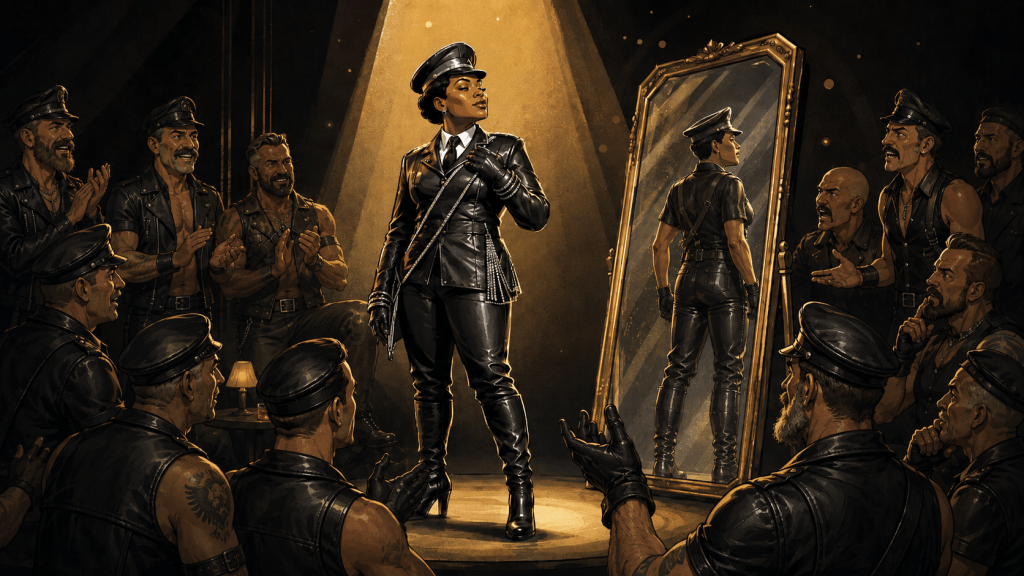
The reaction has something of an identity injury about it, not because leathermen are fragile, and not because objections can be reduced to insecurity, but because a cherished cultural self-image has been disturbed. The mirror has shifted. What some thought of as pure masculinity is being reflected back as something more complicated: styled, coded, eroticised, rehearsed, disciplined, witnessed and dependent on being seen.
For those who inhabit leather as hypermasculine refuge, this can feel destabilising. If leather is too easily equated with drag, then the very thing that allowed a man to feel hard, grounded and safe risks being re-associated with the feminine, the flamboyant, the exposed, the ridiculed. That is not a rational argument against Honey’s win. But it may explain some of the emotional force behind the objection.
We should be able to say that without excusing cruelty.
There is a difference between saying, “I am struggling with what this means for a culture I care about,” and saying, “This person should not belong.” There is a difference between defending the specificity of leather and policing the bodies allowed to embody it. There is a difference between preserving lineage and freezing culture. There is a difference between discomfort and prejudice. The first can be worked with. The second must be confronted.
And I do have some sympathy for the first.
I know what leather means to those of us who find something in it that ordinary gay life does not always offer. It is not simply dress-up. It is not a costume party. It is not a weekend theme. It can be a way of organising desire, discipline, confidence, shame, masculinity and tenderness. It can be the first place a man learns that his body is not merely acceptable, but powerful. It can be the first place he experiences brotherhood without apology. It can be the place where sex becomes honest because the rules are finally spoken aloud.
That is worth protecting.
But what are we protecting it from?
If the answer is commodification, celebrity culture, social media superficiality, loss of mentorship, loss of sexual seriousness, loss of protocol, or the transformation of leather into a fashion accessory divorced from service and conduct, then I am listening.
If the answer is “drag artists”, I am not.
Because there is a difference between defending leather from dilution and defending it from the presence of people who unsettle our expectations. The former is a serious cultural concern. The latter is merely prejudice trying to borrow the language of tradition.
It is worth pausing here on the kind of leather leadership that does not always win the algorithm, but often sustains the culture.
There is, of course, a bias that comes from having met someone, heard them speak, and felt personally moved by the way they understand leather. Jamie Ryan, Mr Leather Europe 2026 and former Mr Leather Dublin, was one of those people for me. He reached the IML stage, representing European leather with clarity and grace, and that achievement deserves enormous congratulations in itself. But more than any placement, it was the clarity of his campaign that stayed with me.
Jamie framed leather not as a spectacle, branding, or an individual triumph, but as kindness practised under pressure. He spoke about May 23rd as a date carrying both public and private meaning: the day Ireland voted for marriage equality, but also the day marked by the loss of his partner, Sir John. In that collision of national progress and personal grief, he located something central to leather at its best: not dominance as hardness, but strength as the capacity to remain open.
His message was not sentimental. It was disciplined. Grief, he suggested, can make us regress. It can make us smaller, angrier, more defended. What brought him back was not status, applause or titleholding, but the kindness of the leather community. That matters, because it reminds us that leather leadership is not only about how convincingly someone inhabits an image. It is about whether people feel safer, taller and more able to enter the room because that person was there.
Jamie also reached for the Irish proverb, “Níl neart go cur le chéile” (there is no strength without unity). That line feels almost embarrassingly necessary at this moment. In a backlash culture, anger so easily searches for a scapegoat. It is easier to decide that Honey Davenport represents everything one fears about change than to ask what leather now needs to protect, and what it needs to release. Jamie’s formulation offers another route: strength not as expulsion, but as unity; not as brittle defence, but as grace.
That is not an argument against Honey. Nor should it be used as one. It is, rather, a reminder of the standard by which all titleholders should be judged. Does the person embody service? Do they understand the people whose flag they carry? Do they make space for the newcomer standing awkwardly at the edge of the room? Do they extend a hand to the trans man entering a male space for the first time? Do they understand the lesbian histories of care, blood drives and community survival that helped keep queer life alive when the wider world looked away? Jamie’s vision of leather was not narrowed by borders, blood or gender. It was bound by conduct.
None of this diminishes Honey’s legitimacy. Honey entered the contest, met the criteria, faced the judges, and won. The point is not that a drag artist should not hold the title. The point is that every titleholder, including Honey, inherits a responsibility larger than the sash. The serious concern, if there is one, must be whether titleholding continues to mean service rather than visibility alone. Jamie’s words help clarify that point; they remind us what any win must be asked to carry.
Honey Davenport has not destroyed leather. Honey has exposed a fault line that was already there: between leather as living culture and leather as guarded fantasy; between leather as lineage and leather as image; between leather as erotic discipline and leather as brand; between leather as masculine refuge and leather as masculine property.
It is possible to say that leather and drag overlap without saying they are identical. It is possible to celebrate Honey’s win without requiring every leatherman to describe his leather identity as drag. It is possible to honour the hypermasculine energy of leather while also recognising that hypermasculinity is itself stylised, symbolic and sometimes defensive. It is possible to defend tradition without turning tradition into a locked door.
This is the nuance we lose when every disagreement becomes a purity test.
The better question is not: “Is leather drag?”
The better question is: “Why does the comparison feel so threatening?”
If the answer is that leather has its own history and should not be lazily collapsed into another queer form, that is fair. Leather is not drag in the same way that drag is not ballroom, ballroom is not bear culture, and bear culture is not leather, even when the same body may move through all of them. A culture that means something must be allowed to have edges.
But if the answer is that drag is too feminine, too artificial, too visible, too Black, too loud, too theatrical, too unserious, too contaminated by women or too close to the thing some men came to leather to escape, then the objection is no longer about preserving leather. It is about preserving a fantasy of masculinity that can only survive by disowning part of queer life.
And that fantasy was always brittle.
Leather at its best is not brittle. It is strong enough to hold contradiction. It can hold the Old Guard and the newly initiated. It can hold silence and spectacle. It can hold masculine severity and camp intelligence. It can hold boots and lashes, cigars and rhinestones, protocol and performance. It can hold those who find themselves through discipline and those who find themselves through display.
It should be strong enough to hold Honey.
That does not mean abandoning standards. Quite the opposite. If anything, this moment should invite more serious conversation about what we expect from titleholders. Not less. Does a titleholder understand the history they represent? Have they served the community? Do they know how to listen across generations? Can they carry visibility without making the title only about themselves? Can they represent leather as more than image? These questions should be asked of every contestant, celebrity or otherwise.
But they should be asked honestly and equally. Not selectively, only when the winner unsettles our expectations.
The irony is that those most anxious about leather being mistaken for drag may be revealing how dependent their leather identity is on being seen in a very particular way. The fear is not only that leather will change. It is that leather will be recognised as something it has always partly been: constructed, performed, witnessed and charged with fantasy.
But construction is not falseness. Performance is not fraud. A mask can conceal, but it can also reveal. Armour can be theatrical and still protect. A boot can be polished for effect and still carry the weight of a life.
Honey’s win does not require us to abandon leather’s specificity. It does not require every leatherman to cheer without reservation, or to collapse his identity into drag if that language does not fit. But it does require us to ask whether our discomfort is rooted in care for leather culture, or in panic at seeing its masculine mirror turned slightly to the side.
Because sometimes the thing we defend as authenticity is merely the performance we have grown used to.
And sometimes the person accused of breaking tradition is simply the one who reveals how much performance was already there.
So congratulations to Honey Davenport: not as a symbol to be argued over, but as the person who entered, stood up, was judged, and won.
Congratulations too to every participant who stepped forward, made themselves visible, and helped make this strange, difficult, generous community what it is.
And congratulations to Atlas Rose, International Mr. Bootblack 2026, whose win reminds us that leather is not only worn, performed or debated. It is cared for, polished, served and passed on.
One response to “The Masculine Mirror: Leather, Drag, and the Backlash to Being Seen”
-
[…] on the blog Blufbear in a long ranging post of support the author also praised Davenport for the […]
LikeLike
 BlufBear
Leave a comment