
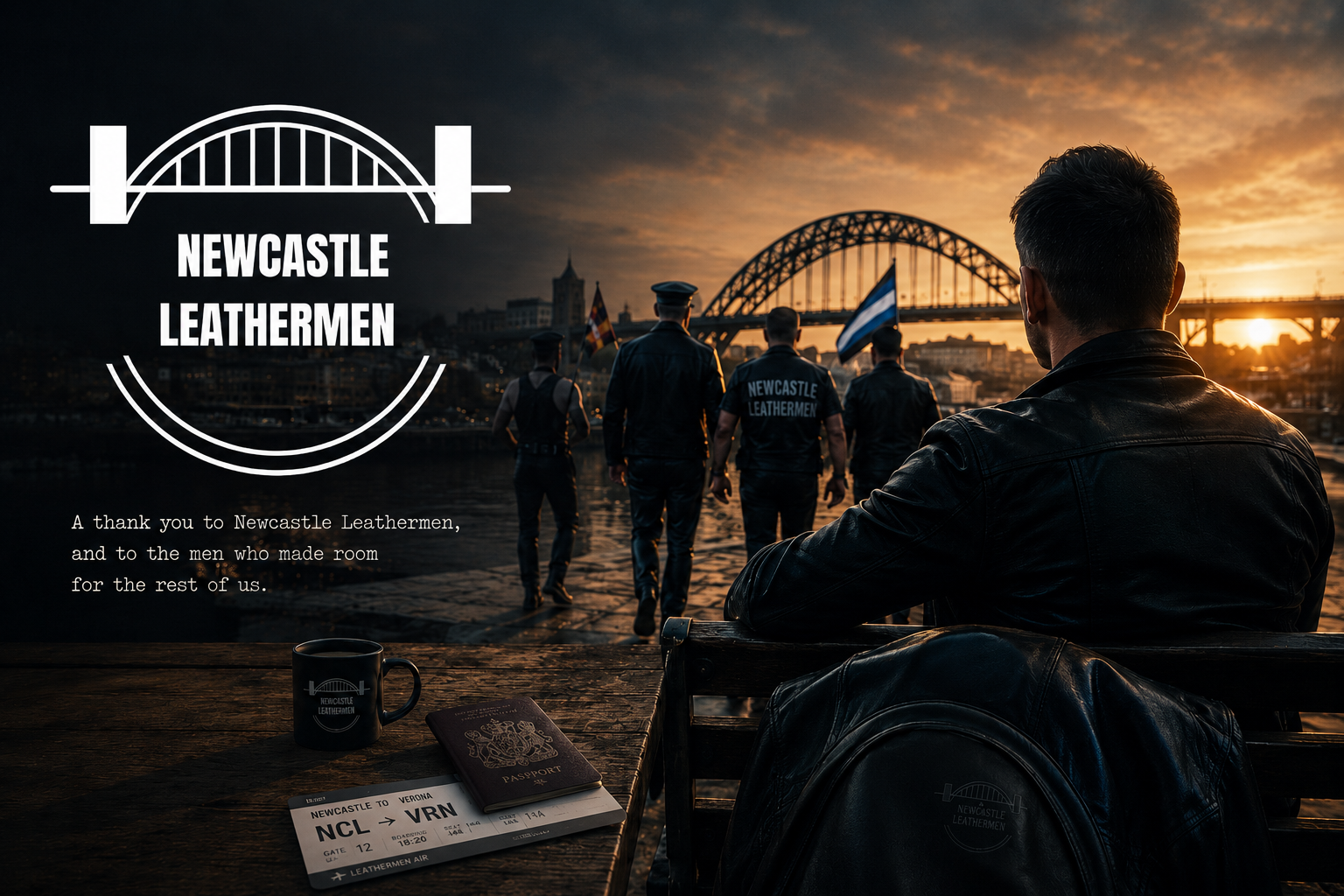
A thank you to Newcastle Leathermen, and to the men who made room for the rest of us.
As I write this, a group of Newcastle Leathermen are gathering for their Friday night social. Tomorrow they will march at Edinburgh Pride alongside Leathermen Scotland representing not only themselves but a community that barely existed when I first arrived in Newcastle nearly thirty years ago.
I will not be joining them. Instead, in a few hours, I will be heading to the airport, exchanging leather for linen and Newcastle for forty-degree Mediterranean heat. While they are pulling on boots and harnesses, I will be wondering whether human beings were ever designed to function in temperatures usually reserved for pizza ovens.
Part of me wishes I was going. Not simply because Pride matters. Not simply because I enjoy seeing leather represented in public spaces, although I do. But because watching this community flourish still feels faintly miraculous.
When I first came to Newcastle in 1998, I had no idea who I was. Or perhaps more accurately, I knew exactly who I was and spent most of my energy trying not to be him.
I grew up in a small market town during the final years of Section 28. We didn’t talk about homosexuality. We talked around it. We joked about it. We warned against it. I remember the AIDS campaigns: the looming black monoliths, John Hurt’s voice sounding like judgement itself, and my mother reassuring me that I didn’t need to worry because it only affected perverts. The irony, of course, was that I was already worrying.
There was no language for people like me. No role models. No stories. What representations existed were caricatures: camp figures offered up for ridicule, men whose difference was tolerated because it was amusing. School offered nothing. Television offered little more. The message was simple enough: people like you exist, but don’t expect to be admired. Certainly don’t expect to be desired.
So I learned to direct my desire elsewhere.
As a psychiatrist, I once explained many of my early experiences through the lens of limerence: the obsessive fixation on unavailable people, the intensity, the fantasy, the longing. These days I think shame is the more important part of the story, because almost every significant crush of my youth had something in common. They were impossible. Straight boys. Confident boys. Athletic boys. Boys who represented acceptance into a world from which I felt excluded.
There was Matthew. There was Stuart. There was Jacob. There were housemates at university, course mates, friends, fellow students. The details changed but the pattern remained remarkably consistent. I would find a man who embodied something I admired and attempt to earn proximity through usefulness, loyalty, generosity, humour, emotional labour or quiet devotion.
The tragedy was that many of them genuinely liked me. They simply didn’t love me. And because I had grown up believing that love between men was somehow impossible, I never thought to look elsewhere.
Newcastle’s gay scene at the time didn’t help. I have fond memories of it; some of my happiest nights happened there. But it often felt as though the soundtrack had become trapped in 1997 and nobody could find the off switch. The scene queens ruled their territories with admirable efficiency. Camp was king. Pop divas were mandatory. Looking back, it was joyous in its own way. It just wasn’t me.
I was the awkward young man who liked motorbikes, leather jackets, melancholic rock, psychology textbooks and intense conversations. I was searching for something I couldn’t quite name.
Eventually London provided some answers. There I discovered leather communities, fetish spaces and forms of masculinity that felt familiar rather than alien. For the first time I met men who seemed comfortable occupying both strength and vulnerability. Men who understood that leather wasn’t really about clothing. It was about identity, belonging and recognition.
But London came with London prices. Eventually practicality won, and I returned north believing I was leaving much of that world behind.
Instead, something remarkable happened. Newcastle Leathermen appeared.

What began as a handful of people creating opportunities for connection has become something far larger than anyone could reasonably have expected. The group recently celebrated its fourth anniversary. On its anniversary we had our first Newcastle Leather Weekend, and it was an extraordinary success. The visibility, the attendance, the warmth, the sheer sense of possibility exceeded anything I imagined when I moved back to the North East.
What moved me most was not simply seeing men in gear. It was seeing men in gear without apology: men laughing, organising, flirting, greeting newcomers, taking up space and making no attempt to soften themselves for public comfort. For someone raised to believe that queer desire had to be hidden, mocked or feared, there is something quietly healing in that kind of ordinariness. A leather social may not look like therapy, but sometimes belonging does its work without announcing itself.
The success of Newcastle Leathermen has helped create something wider too: gear nights, rubber nights, visible fetish communities, and people feeling able to show up authentically rather than editing themselves into acceptability.
The men responsible know who they are: Duncan, Andy and John, among others. Some founded it. Some nurtured it. Some simply kept turning up month after month until the thing became self-sustaining. They have created far more than a social group. They have created a home from home.
And I should be honest: I do not prioritise that home as much as I should. Too often, Friday comes around and I am tired, still at work, overwhelmed, or running on the fumes of a social battery that gave up several hours earlier. I tell myself I will go next time. I mean it, usually. But communities are not sustained by intention alone. They survive because people keep turning up, keep organising, keep opening the door for the rest of us when we finally manage to walk through it. I am grateful for the men who keep that door open.
That dedication from the core group is not invisible to me. It is deeply valued. And the more I write about community, belonging and the need to nurture queer spaces, the more I realise I have to practise what I preach. So consider this a small promise, made publicly: I will do better.
Even the WhatsApp group has become part of the mythology. Like many queer spaces, it oscillates wildly between heartfelt support, shameless flirting, event planning, discussions about boots, and the occasional political debate that may or may not have been started by me. I still laugh remembering one member’s suggestion that perhaps we should spend less time discussing politics and more time flirting and imagining me bound in a leather sleepsack.
At the time I was forced to admit this was not an entirely unappealing proposition. The image remains amusing precisely because it captures something essential about this community: its ability to balance seriousness with absurdity, activism with mischief, and belonging with humour.
And perhaps that is what I am most grateful for. Not the events. Not the gear. Not even the friendships, although all of those matter enormously. What matters most is that this community offered an alternative ending to the story I inherited as a child.
The frightened boy watching AIDS adverts. The teenager falling in love with straight friends. The student trying desperately to earn affection. The young doctor searching for himself in London. All of them were looking for the same thing: a place where they could stop performing and simply belong.
Perhaps that is why I feel such loyalty to it. Newcastle Leathermen did not invent the man I am, but it gave him somewhere to stand.
As a group of Newcastle Leathermen prepare to march through Edinburgh tomorrow, I find myself thinking about how extraordinary that would have seemed to my younger self. Not because leather men exist, but because a community like this exists here, in Newcastle, for people like us.
And for that, I am profoundly grateful.
One response to “Bound Together: Newcastle Leathermen”
-
It was all going reasonably well (I fundamentally disagree with the claim ‘ There was no language for people like me. No role models. No stories.’) until the phrase ‘queer spaces’ came up. Although admirable that ‘LGBTQ+’ was avoided, the word ‘queer’ is if anything even more likely to provoke me into a red rage. Perhaps that’s why I don’t go out much, I refuse to engage with radical ideological constructs.


Leave a Reply