
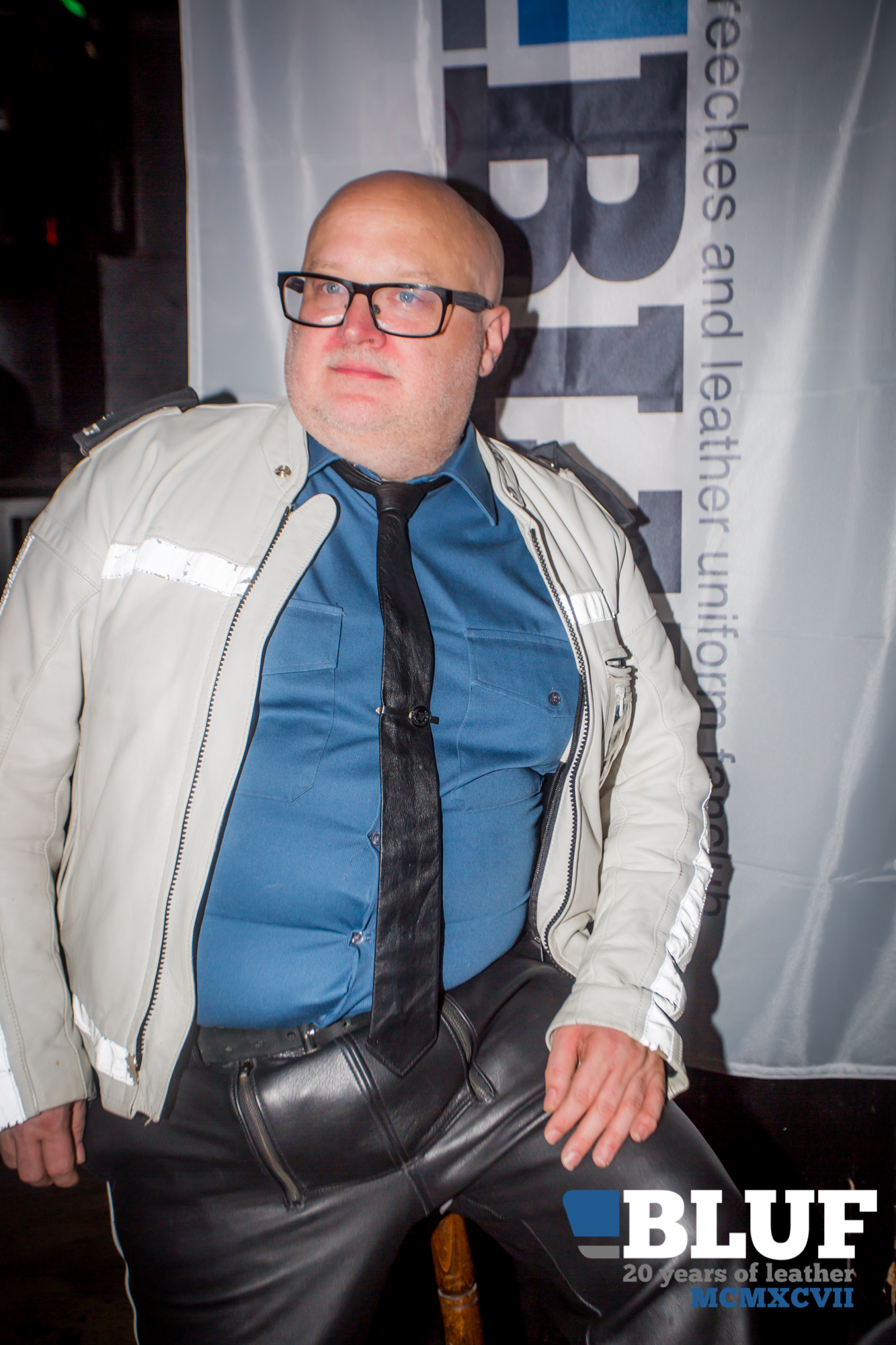
For seventeen years, Nigel Whitfield helped turn a specialist leather website into an international community. But what happens when caring for a community consumes the person doing the caring?

When I asked Nigel Whitfield how it felt to be handing over BLUF after seventeen years, he did not pause to assemble a gracious retirement speech.
“That’s a bloody relief, frankly.”
It was not the ceremonial answer I had expected. There was no polished talk of passing the torch, no sentimental insistence that it had all gone by too quickly.
Instead, there was relief.
The past two years had been brutal. Nigel’s mother died at the beginning of 2024 while he was recovering from thyroid surgery. Five days after her funeral, he was told that cancer had been found. Further surgery and radioactive treatment followed. Then, in the spring of 2025, he needed a pacemaker.
“That was the point at which I decided I needed to give something up.”
BLUF was the thing consuming the most of him.
Nigel had spent seventeen years as custodian of BLUF, the Breeches and Leather Uniform Fanclub, but “custodian” is one of those restrained words that conceals far more than it reveals. It suggests somebody occasionally polishing the silverware and making sure the doors are locked. In reality, Nigel was maintaining the website, building its apps, managing its legal and financial structures, responding to members, resolving disputes, supporting organisers and keeping pace with an expanding body of international regulation.
As parts of the role were gradually transferred to the men succeeding him, Nigel began to recognise how much mental space it had occupied.
There was the inbox. The applications. The hosting. The regulations. The complaints. The questions that were tedious, complicated or sometimes deranged.
One man whose application was rejected because he did not own the required uniform wrote back accusing BLUF of treating him as badly as Black people had been treated in the American South.
Nigel was unimpressed.
“Slavery, lynching, Jim Crow laws. Oh yeah, that’s exactly like not being able to join a uniform club because you don’t have a uniform, isn’t it?”
He has accumulated some stories.
“I’ve had some doozies like that over the years,” he said. “I don’t miss that.”
This is the tension at the heart of Nigel’s story. We speak fondly of community as though it were something warm and naturally occurring, something that simply appears when enough like-minded people gather together. We are less inclined to ask who answers its emails, pays its bills and absorbs the anger of those who believe belonging should require nothing from them.
What happens when caring for a community consumes the person doing the caring?
No Longer Nigel From BLUF
Nigel told me that he had been discussing with his therapist the prospect of no longer being “Nigel from BLUF”.
He wanted to become simply Nigel.
Running BLUF had changed his experience of the leather scene it was supposed to help him enjoy. He might go to the Backstreet or Folsom Europe hoping to look around, flirt or simply spend time among other leathermen. Then someone would approach him with a membership query, a website problem or a question about the campaign to protect the Backstreet.
His position could “cramp your style”, as he put it.
There is a particular irony in that. Uniform can allow a man to disappear into a shared identity. Nigel joked that a room full of men dressed in Langlitz could begin to resemble a collection of interchangeable men in their late thirties and early forties.
“There’s definitely a type.”
Yet the more Nigel became associated with BLUF, the less able he was to disappear into the crowd.
He had become the public face of something that was, for him, rooted in private desire.
Before Nigel Built an Online Home
Before Nigel built an online home for thousands of men, he had first experienced the shock of finding a physical place where his own desires made sense.
He remembers kinky thoughts from childhood. In tying-up games, he wanted to be the one restrained. He was fascinated by uniforms, bondage and the Robomen in the Peter Cushing Dalek films. A trashy horror novel introduced him to the idea of electricity and genitalia while he was barely into his teens.
He knew he was “a pervert”, as he cheerfully puts it, before he properly understood that he was gay.
Boarding school brought the cadet force and compulsory afternoons in uniform. Later came SM Gays, Sadie Maisie at the London Lesbian and Gay Centre, the SM Pride march and the wider London scene of the early 1990s.
Then a man he knew online, Biker Ed, took him to the Backstreet. It was Nigel’s first time riding pillion and his first time entering the venue.
“This is sort of home,” He remembers thinking.
That sentence stays with me because I recognise it.
There are places we discover as adults that appear to explain something we had previously experienced only as an absence. Until then, desire can feel like a collection of unconnected fragments. The boot. The jacket. The smell of leather. The man who looks both dangerous and composed. The wish to submit without becoming lesser. The comfort of standing among men dressed much the same way.
Then suddenly there is a room where those fragments form a language.
Nigel’s attraction to uniform was never simply a fantasy of command. Men sometimes told him that they loved the BLUF look but could not join because they were submissive.
He would point them towards the Marine standing beside the Oval Office doors.
The Marine is in full ceremonial uniform. He is immaculately presented. He is also there to take orders.
“It’s perfectly possible to be into a full uniform and be the submissive person taking orders.”
For some men, the uniform creates confidence and power. For others, dressing perfectly is part of offering themselves. They are presenting the best version of themselves to the person they wish to serve.
Uniform can make a man stand taller. It can also allow him to kneel with greater certainty.
From UK-MOTSS to BLUF
Nigel’s history of queer community did not begin with BLUF.
In 1990, with technical assistance from a friend, he created UK-MOTSS, an email list that grew out of the soc.motss newsgroup. At that time, internet access remained largely concentrated in universities, technology companies and a small number of early domestic users.
At its height, the list had around 400 participants and could generate hundreds of messages a day. Its rules were relatively simple: remain civil, do not question the validity of how another person describes his or her sexuality, and try not to let every disagreement become an endless argument.
Other projects grew from it. Digital Diversity taught queer people what existed online and how to access it. Nigel helped develop online communities and mailing lists associated with Stonewall, OutRage!, ILGA-Europe, queer people in Singapore and Europeans living with HIV.
He was also a technology journalist. He studied computing science at Imperial College, became the editor of a computer magazine and later wrote for publications including The Independent, The Guardian, The Times and The Register.
By the time BLUF’s founder, Leon Jacobs, announced that he wanted to step down in 2009, Nigel had already spent almost twenty years helping queer people find one another through technology.
UK-MOTSS and BLUF were very different communities, but they answered the same underlying problem:
How do people who believe themselves isolated discover they are not alone?
The early internet was not simply a faster means of sending information. For queer people, it was a way of discovering that an experience believed to be peculiar or private might be shared by hundreds of others.
BLUF did the same for a more particular desire.

A Community Founded Because Someone Wanted to Get Laid
Nigel has little interest in dressing BLUF’s beginnings in false solemnity.
“The intention of BLUF was so that Leon could get laid.”
Leon had found an online leather directory but could not find anything specifically devoted to men wearing breeches and leather uniforms.
That was what “made his dick twitch”, Nigel said, and so Leon created the place he wanted to exist.
Many of its earliest members were personally invited. Nigel suspects the selection process was not entirely disconnected from whom Leon wanted to shag.
This is not a trivial origin. Nor is it something BLUF should be embarrassed by.
Queer institutions often begin because somebody desires something for which no space yet exists. A man wants to meet other men dressed in a certain way. He creates a website. The website gains members. The members begin meeting. They form friendships, organise events, argue about rules, create traditions and eventually inherit responsibilities their founder could never have imagined.
Desire becomes infrastructure.
It is also why Nigel rejects claims that BLUF was founded to sit at the summit of leather culture.
BLUF was not created to determine who qualified as a real leatherman. It was created for men who liked a particular look.
There is no BLUF protocol.
“We’re not Old Guard or New Guard,” Nigel said. “We’re Right Guard.”
He is scathing about leather myths that have hardened into supposed historical law: councils of elders, covering ceremonies and elaborate systems through which somebody must allegedly progress before being entitled to call himself a Master.
People are free to enjoy protocol. Nigel objects only when personal practice is promoted as the sole authentic inheritance of leather.
A ritual can be meaningful without being ancient. A preference can be sincerely held without becoming compulsory for everyone else.
BLUF’s purpose was simpler. It gathered men who were fans of the gear.
Taking Over BLUF
Nigel joined BLUF in around 2005, but not at his first attempt.
His initial application was rejected because his uniform was not up to standard. He improved it and applied again.

By around 2007 he had taken over organising BLUF nights at the Backstreet. When the organisation’s web-hosting costs became difficult for Leon to sustain, Nigel moved the site onto spare capacity on a server he used for his business.
So when Leon decided to leave, Nigel already knew something of the organisation’s internal workings. He also understood queer online communities and possessed the technical skills required to rebuild the site.
He put forward a proposal. Another man did too.
Leon chose Nigel.
The other candidate, in Nigel’s account, “flounced off into the depths of the internet to whine about how things weren’t being done right”.
There are few human dramas that cannot be improved by somebody flouncing into the depths of the internet.
Modernise or Wither
When Nigel took over, BLUF had around 2,200 members. The website contained a database, but members could do little with it. They could alter some profile text, but could not upload their own photographs or message one another properly. Applications and images had to be processed manually by email.
Nigel believed the site had to change.
He had already seen what could happen to leather organisations that failed to modernise. He recalled visiting one long-established club and finding a few older men sitting in a pub, chatting among themselves and not even dressed for the occasion.
The problem was not that they were older. Leather culture should be one of the places where gay men resist the wider culture’s impatience with age.
The problem was that there was no visible route in for anybody new.
If a younger man entered and found only an established friendship group repeating the same meeting it had held for years, what reason was there for him to return?
Nigel rebuilt the website. Members could upload their own photographs, send messages and complete applications online. The weekly email told people who was attending which events. The calendar was made public and expanded beyond BLUF’s own gatherings to include events organised by other clubs and communities.
This was a deliberate decision.
BLUF had reach. Nigel believed that reach should be used to support the wider leather scene, not merely to promote itself.
He later built mobile apps for Android and iPhone. Some members thought he was wasting his time. Today, he estimates that around 60 per cent of access comes through the app.
Leather culture did not have to abandon its history to meet men where they now were.
Modernisation was not the opposite of preservation. It was the condition of survival.
The Invisible Machine Beneath the Leather
To most members, BLUF was a number, a profile, an event listing and a collection of photographs of men in leather.
To Nigel, it was also an increasingly complicated international platform.
There were two complete rebuilds of the website and half of a third. There were the mobile apps, an earlier Windows application, hosting, payments, age verification, privacy and security.
There were registrations with communications regulators in different countries so that password-reset codes could be sent by text. There were obligations under GDPR, the Information Commissioner and the Online Safety Act. There were annual risk assessments addressing everything from trafficking and abuse to weapons and drugs.
Apple and Google required the apps to be updated to remain in their stores. Payment providers changed their systems. Age-verification companies altered what services they were willing to offer. International trademarks required protection and renewal.
Every photograph uploaded to BLUF was classified according to what it contained. That meant that if Apple, Google or a national regulator suddenly prohibited a particular category, the site could filter those images rather than begin again from nothing.
Then there were the people.
Applications. Complaints. Volunteer disputes. Members who believed that buying an expensive jacket gave them greater authority. Organisers who fell out with one another. Men who wanted Nigel to adjudicate their grievances as though he were both leather pope and human resources department.
What began as a website for men who liked leather uniforms had acquired many of the burdens of a small international institution.
Nigel did much of the technical work himself. Calculated by the hour, he says he was paid less than minimum wage. For much of the past decade, he effectively stopped pursuing his journalism career and concentrated on BLUF.
He believes he would have substantially more savings had he made a different decision.
He has not had a proper holiday since 2013.
This is the part of community we prefer not to see. We celebrate the gathering and forget the person who updated the calendar. We value the website but not the lost weekend spent repairing it. We admire the endurance of an institution while remaining incurious about the life from which that endurance was taken.
Nigel does not present himself as a martyr. He made choices. He cared about the work and believed in the community.
But care without limits can become a trap.
His advice to anyone taking on a volunteer role is to have an exit plan. Commit to two years, or five. At the end, make a conscious decision about whether to continue.
“Don’t end up accidentally stuck doing something for seventeen years.”
A Gate, But Not The Whole Scene
BLUF has a dress code. There is no honest way to describe it without acknowledging a degree of gatekeeping.
Nigel does not regard gatekeeping as automatically wrong.
A football club may require football boots. A choir may expect its members to sing. A community devoted to a particular form of leather uniform may reasonably ask members to own something resembling that uniform.
The problem begins when the threshold ceases to protect the purpose of the group and becomes a means of asserting superiority.
“If your idea of leather is a harness and a jock, well, that’s fine,” Nigel said. “We’re not saying you’re not leather. We’re just saying that you’re not wearing a uniform, and our criteria is a uniform.”
BLUF defines BLUF. It does not define the whole of leather.
Nigel is equally impatient with the claim that membership requires a fortune. Most of his own gear was bought secondhand. A workable uniform can begin with leather jeans, boots, an inexpensive workwear or security-style shirt and a leather tie. Other pieces can be added later.
There is nevertheless snobbery. Some members behave as though owning Langlitz or VK79 makes them more authentic than those wearing less expensive gear.
“There are some people who give the club a bad name by being absolute snooty arseholes.”
Even membership numbers become objects of status. Some men believe that having a low number makes them a more significant leatherman.
Nigel has found a use for this vanity. Members prepared to pay £25 can acquire an available number below 1,000. Their profiles still show the year they actually joined.
Numbers below 100 are reserved for people who have made a sustained contribution to BLUF.
Money can buy the appearance of seniority. Service earns recognition.
There is a class tension here that leather culture does not always acknowledge. Clothing offers transformation, but it can also reproduce the hierarchies men encountered at school: the official uniform and the cheaper copy, the approved brand and the unacceptable substitute, the boy who belongs and the one who remains outside.
Some men who once knew exclusion become generous gatekeepers.
Others become delighted that the gate is finally theirs to control.
Inclusion and the Limits of a Bounded Space
Around 2012, a trans man wrote to Nigel asking whether he could join BLUF.
Nigel considered what refusing him would achieve. The applicant could simply create another email address, apply without disclosing that he was trans and join anyway.
Refusal would penalise honesty while accomplishing nothing.
BLUF did not require photographs of genitals or documentary proof of sex.
“We’re not going to start rummaging in people’s pants.”
The rule became straightforward: if somebody said he was a man, he could join.
Nigel also removed wording prohibiting “cross-dressing” after learning that some people interpreted it as anti-trans. The original intention had been to stop members posting lingerie photographs on a uniform-focused site. Once the effect of the wording became clear, it was changed.
Questions about women and non-binary people are more difficult. Nigel believes inclusive mixed spaces are valuable, but he also thinks there can be legitimate reasons for male-only and female-only groups.
This is an uncomfortable tension, but not one resolved by pretending that every bounded community is inherently oppressive or that every boundary is inherently benign.
A space can be inclusive within its purpose while remaining specific about whom and what it exists for. It can also use “purpose” as a respectable disguise for prejudice.
The work is in knowing the difference.
Nigel is not sorry that some of these decisions now belong to BLUF’s new custodians.
When History Stops Being Safely Historical
Nigel’s position changed over time on Nazi imagery.
BLUF had never officially permitted it, but enforcement became stricter after a member was exposed in the tabloid press for material posted elsewhere and lost his job.
There was also a broader change in context. Imagery that some leather and skinhead communities had treated as historical transgression began to reappear in contemporary political movements and on the streets.
It was no longer possible to pretend that these symbols belonged safely to the past.
Nigel recognises the complexity of private fantasy. A Jewish man, a gay man or a man of colour might wear a fascist uniform as an act of appropriation, turning the imagery towards precisely the kind of sex and identity its creators would have despised.
“That is a massive fuck you.”
But it is not one BLUF is prepared to publish.
Private fantasy does not require institutional endorsement. What consenting adults do in a bedroom is different from what a community platform chooses to display.
BLUF tightened its rules, blocked certain terms in messages and introduced checks for coded references when profiles were updated. Nigel had planned a wider review of older profiles, but bereavement and illness interrupted the work.
It is one of the tasks he leaves behind.
The Moment BLUF Nearly Vanished
For all its members, events and international reach, BLUF came close to disappearing during a trademark dispute in Germany.
A man who had been involved in organising events registered BLUF Berlin as a trademark. When another organiser was later allowed to hold events in the city, legal action followed.
Claims were made about who had created BLUF Berlin and what had been known about competing events. Nigel and others began assembling evidence.
Once the first body of that evidence reached the opposing lawyers, the case collapsed. BLUF recovered control of the domain, and the other party was ordered to meet its legal costs, although the dispute still cost the organisation several thousand euros.
Before that happened, Nigel came within a day or two of deciding that BLUF would have to declare itself insolvent and close.
He was not prepared to remortgage his flat.
After years of unpaid and underpaid labour, BLUF still depended upon whether one man could find enough money to respond to a legal threat.
The organisation survived. Its trademarks were subsequently registered in the European Union and the United States.
Visibility can give an organisation the appearance of permanence. The dispute revealed how precarious that permanence remained.
Community as a Verb

Nigel’s proudest answer was, at first, almost evasive.
What was he proudest of that most members probably did not know about?
“Surviving.”
He struggles with praise. He is more comfortable describing systems, disputes and other people’s contributions than claiming his own importance.
But he is proud that BLUF proved it was more than “just an internet club”.
Its beating heart, he says, is its events.
In the previous year, he estimated that BLUF had been associated with hundreds of gatherings, many of them informal socials without an enforced dress code. Thousands of people attended.
That reach matters in a period when so many leather venues have disappeared.
Nigel does not blame their loss on the internet alone. He describes a perfect storm: gentrification, rising property costs, staffing pressures, smoking bans, cheap supermarket alcohol, changing habits and the convenience of apps.
BLUF cannot recreate the Backstreet. It cannot restore every bar lost to redevelopment or economics.
It can help people gather.
In cities with surviving leather venues, BLUF events can bring customers through the door. Elsewhere, a conventional pub can become a leather space for a night simply because enough leathermen decide to occupy it together.

Nigel once heard volunteers restoring a park described as “practising community as a verb, not as a noun”.
It became his preferred description of what community requires.
Community is not the existence of a Facebook group. It is not a logo, a membership card or a declaration that one belongs to a scene.
It is the person who books the venue, designs the poster, updates the calendar and welcomes the newcomer. It is the person who turns up early and the one who stays late. It is also the people who decide to leave the sofa, put on the gear and attend.
This is where clubs such as Newcastle Leathermen enter the story.
They are not branches of BLUF, nor does their identity belong to it. But they exist within a leather ecosystem shaped by people such as Leon and Nigel, by the Backstreet, by the early online organisers and by the men who proved that scattered desire could become organised community.
When Jamie Ryan (Mr Leather Europe 2026 told me at a Newcastle Leathermen event that I had to speak to Nigel, he was pointing me towards part of that inheritance.
Local clubs depend upon local energy. But their members find one another through networks, websites, events and histories built by people who were willing to create a space before anybody could be certain others would come.
BLUF Members 4, 6, and 8
BLUF is now being run by a team rather than another single custodian.
Its new leaders are members 4, 6 and 8.
The low numbers are not claims of ancient membership. Nigel long ago developed a system through which certain numbers could be reassigned, with the true joining year still shown on the profile. Numbers below 100 are generally reserved for those who have given sustained service.
There is something fitting about the new team inheriting numbers associated with contribution rather than purchase.
The BLUF they receive is far larger and more complicated than the one Nigel inherited. It includes websites, apps, events, finances, data protection, content moderation, international regulations, vendors and volunteers.
One man could no longer reasonably manage it all.
Nigel has documented what he can and remains available to answer questions. What he does not want is to become a backseat driver.
Leon did not hover behind him in 2009, objecting whenever BLUF changed. Nigel wants to offer the same freedom to the men who follow him.
He hopes they preserve BLUF’s approachability, its security and its commitment to useful features. He hopes they continue supporting the wider leather scene rather than treating BLUF as its pinnacle.
“You don’t have to join BLUF to be a leatherman.”
His final act of custodianship is to allow the organisation to develop without him.
The Room I Wanted to Enter
My own relationship with BLUF began with wanting to qualify.
For me, BLUF represented a room I wanted to enter. Long before I knew Nigel, I knew the dress code, and I knew I had not yet met it. Like many men, I assembled the outfit gradually, not because somebody demanded expensive leather, but because I wanted to belong.
BLUF gave that desire a visible standard. I found the trousers, the boots, the shirt and the tie that would allow me to present myself at the threshold.
At the time, I thought mainly about the room.

I imagined the men inside it. I imagined the reassurance of standing among people who understood why the effort mattered. I imagined the transformation of putting on the uniform and no longer having to explain why it felt important.
I thought less about the man keeping the room open.
Before Nigel built an online home for thousands of men, he had experienced the shock of walking into the Backstreet and recognising home for himself. He then spent seventeen years extending that possibility to other men.
There is something profoundly generous in that, even if the motivation was never wholly altruistic and should not be sanitised into sainthood.
Nigel liked the gear. He wanted the community. He had the skills to build the systems it needed. He also possessed the particular mindedness required to sit with the tedious, invisible work long after the excitement of creating something new had passed.
That work did not belong to him alone. BLUF was sustained by local organisers, volunteers, event hosts and members who kept turning up. Leon created the original space. Nigel modernised it, protected it and helped it grow. Members 4, 6 and 8 now inherit responsibility for whatever it becomes next.
But homes do not build or maintain themselves.
Looking back at my own application photograph now, I no longer see someone showing off his leather. I see someone hoping he had finally found his people.
That is why Nigel’s work matters to me.
He did not simply maintain a website. Along with Leon before him and the volunteers who continue after him, he kept open a door that thousands of men have quietly walked through.
What happens when caring for a community consumes the person doing the caring?
Eventually, if the community has grown strong enough, he must be allowed to put it down.
After seventeen years, the inbox belongs to somebody else.
Nigel from BLUF can finally try being Nigel again.
One response to “When Nigel from BLUF Became Nigel Again”
-
A superb write-up – thank you so much :)


Leave a Reply