
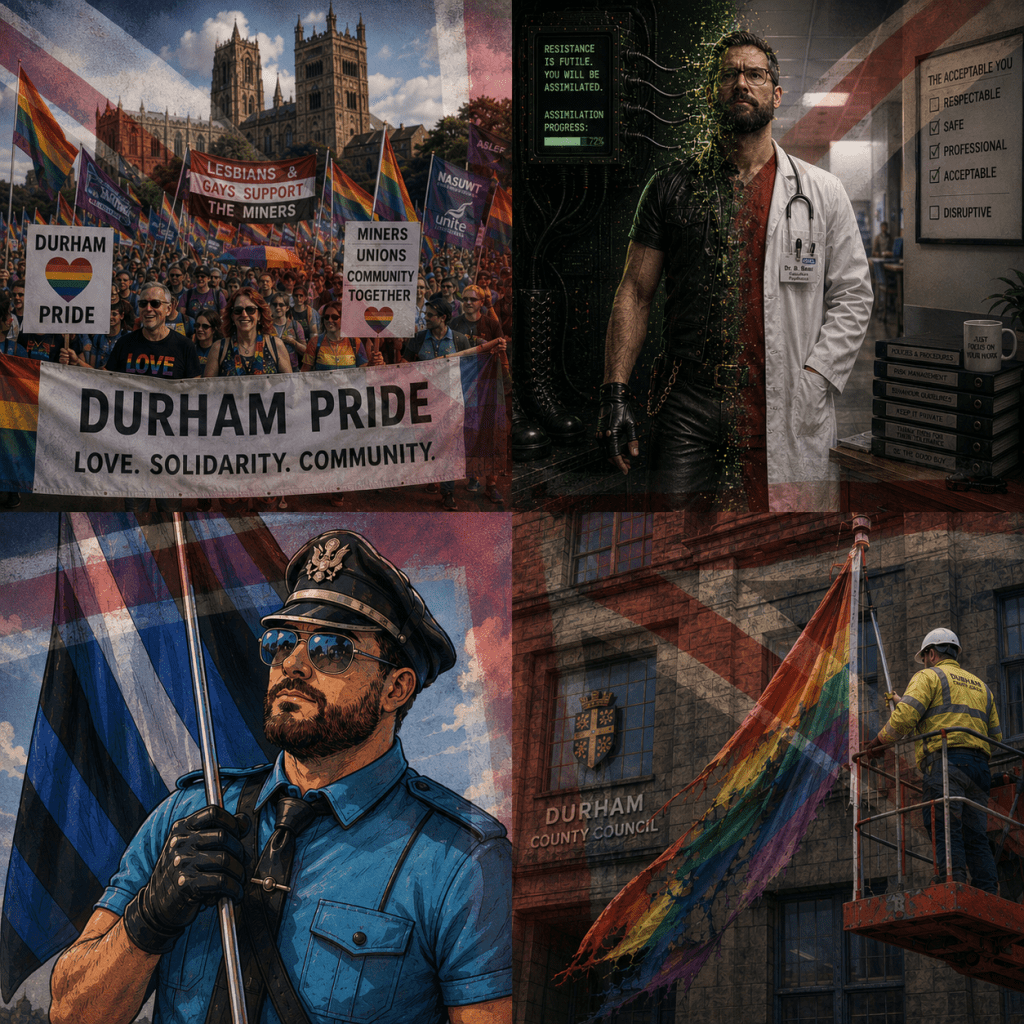
Every year after Pride, I make the same mistake. I tell myself I am not going to read the comments, and then inevitably I do. Partly this is professional curiosity. As a psychiatrist, I am interested in the stories people tell themselves and each other, particularly when those stories become defensive, repetitive or disproportionate. Partly it is personal. As a gay man who grew up during the long cultural shadow of Section 28 and the AIDS crisis, I have spent much of my life trying to understand why the visibility of some people provokes such discomfort in others.
This year Durham Pride arrived carrying more political weight than usual. Following Reform UK’s victory in Durham County Council elections, support for Pride became a public controversy. Darren Grimes, now Deputy Leader of the Council and himself a gay man, argued that taxpayers should not be funding what he presented as a contested political cause. Pride was recast not as a civic event, not as a celebration, not as a point of local solidarity, but as an ideological indulgence from which the council should distance itself.
The irony is that the attempt to marginalise Durham Pride appears to have achieved the opposite. Trade unions, community organisations, local businesses and ordinary residents stepped forward. The Durham Miners’ Association, whose history remains intertwined with LGBTQ+ solidarity through the legacy of Lesbians and Gays Support the Miners, backed the event. The Guardian reported that the support from unions far exceeded the funding withdrawn, with Durham Pride described as the largest in its history. (The Guardian) Equity, the TUC, Unite, Aslef, CWU, NASUWT and others helped turn an attempted act of symbolic withdrawal into a renewed statement of solidarity. (Equity)
That matters. Durham Pride was never simply about rainbow flags. It was about whether queer people are allowed to occupy public space without apology. It was about whether civic acceptance is granted only to those who make themselves convenient. It was also about memory. The Durham Miners’ Association deserves particular credit here, not merely for material support, but for recognising that solidarity is not a slogan to be admired retrospectively in a film or museum. It is something that must be practised when the political weather changes.
The Comments Never Change
The comments beneath the coverage were, however, depressingly familiar. “When is straight Pride?” “Nobody cares if you’re gay anymore.” “Keep it in the bedroom.” The remarkable thing about these comments is not their hostility but their predictability. They appear every year with such consistency that one could almost automate them. Different names, different profile pictures, different local papers, but the same emotional rhythm.
The contradiction is obvious. We are told Pride is unnecessary because LGBTQ+ people are now accepted, yet the existence of Pride continues to provoke disproportionate anger. We are told nobody cares if someone is gay by people who care enough to spend their evening arguing about it on social media comment boards. We are told sexuality should remain private in a culture where heterosexuality is so omnipresent that it is mistaken for neutrality. The objection is rarely to visibility itself. The objection is to queer visibility.
Growing up in the 1980s and 1990s, I did not learn shame because somebody formally instructed me to feel it. I learned it through absence. Through the things that could not be said. Through the people who could not be seen. Through a culture that provided no meaningful reflection of who I might become. Children are remarkably good at absorbing lessons that nobody consciously teaches. When nobody like you exists in public life, you begin to wonder whether you are supposed to exist at all. That is why visibility matters. Not because every identity requires celebration, but because invisibility has consequences.
That is also why the political reaction to Durham Pride felt so instructive. It was not merely disagreement about a local funding decision. It was an attempt to control the meaning of visibility itself.
What struck me most, however, was not the event itself but some of the reactions to it. Reading through social media comments and local discussions, I was reminded of a local blog reflecting on Durham Pride which quoted Hannah Arendt’s observations about propaganda and cynicism. Her argument was not that people become incapable of recognising falsehood, but that they can become attached to narratives in ways that render contradiction irrelevant. If one claim fails, another emerges. The conclusion remains fixed while the evidence rearranges itself around it.
That felt uncomfortably relevant while reading some of the responses to Durham Pride. If Pride receives funding, it becomes evidence of ideological capture. If funding is withdrawn and Pride succeeds anyway, that becomes proof the funding was unnecessary. If LGBTQ+ people are invisible, they are accused of hiding agendas. If they are visible, they are accused of imposing them. The target keeps moving because the destination remains unchanged. The minority itself remains the problem.
This is where Reform UK’s approach feels particularly corrosive. Its politics depends upon turning social difference into grievance, then presenting that grievance as common sense. Pride becomes not a civic event but an imposition. Trans people become not neighbours, colleagues or family members but symbols of social disorder. Diversity becomes not the ordinary texture of modern Britain but evidence that someone, somewhere, is being silenced or displaced. This is divide-and-rule politics dressed up as plain speaking.
Darren Grimes’ position sits uncomfortably within that machinery. As a gay man, he can present his critique of Pride as a form of insider realism rather than hostility. Yet that is precisely what makes it politically useful. He appears to offer reassurance that the problem is not LGBTQ+ people as such, but only the wrong kind of LGBTQ+ visibility: too political, too trans-inclusive, too confrontational, too unwilling to know its place. In that sense, he is not merely invoking respectability politics; he is helping feed a wider project that benefits from dividing minorities into the acceptable and the unacceptable.
Beneath the specific disagreement lies a much older question: what must a minority do in order to be accepted?
The Old Bargain of Respectability
This is where Durham Council Deputy Leader Darren Grimes becomes such an interesting figure. Not because he is gay, but because his position echoes a very old tradition within minority politics. Throughout history, marginalised groups have often faced a strategic choice. One path seeks acceptance through assimilation. It argues that progress is achieved by demonstrating similarity to the majority. The message is simple: we are ordinary, respectable people who deserve equal treatment.
There is nothing inherently foolish in that strategy. There were arguably moments when it achieved real progress. Before Stonewall, many homophile organisations deliberately presented homosexuality in ways designed to reassure wider society. Men wore suits. Women wore dresses. Campaigns emphasised normality, discretion and conformity. The problem is that respectability politics contains a hidden trap. Acceptance becomes conditional. Rights are no longer grounded in dignity, but in successful performance. The question quietly shifts from “Are gay people equal?” to “Which gay people are acceptable?”
That is the trap.
Because once acceptance depends upon conformity, there will always be another demand. Tone down the leather. Leave the drag queens at home. Stop talking about trans people. Be less political. Be less visible. Be less different. The boundaries of acceptability are never fixed because they were never designed to include us. They are designed to domesticate us.
It is difficult not to think of the Borg from Star Trek: “You will be assimilated.” The promise is belonging. The price is individuality. You are welcomed, but only after the parts that make you different have been stripped away.
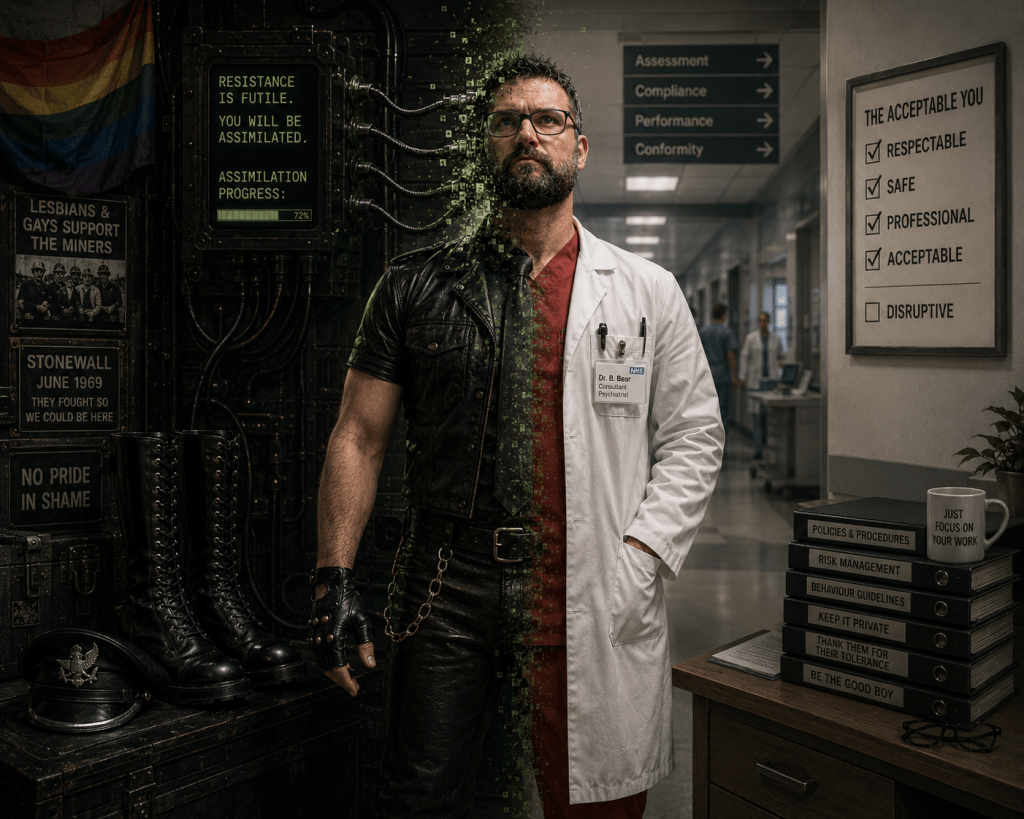
Listening to contemporary criticisms of Pride, I sometimes hear echoes of that older argument. Not that LGBTQ+ people should disappear entirely, merely that we should be a little less visible, a little less political, a little less trans, a little less disruptive, a little easier for everyone else to digest. History suggests that this bargain rarely ends where it begins. The people who complicate the respectable image are always the first to be offered up as liabilities: drag queens, trans people, gender non-conforming people, leather and fetish communities, sex workers, anyone deemed too loud, too strange, too sexual, too embarrassing or too difficult to assimilate.
The danger of conditional acceptance is that there is always somebody further down the ladder. Today, that burden falls most heavily on trans people. We are already seeing this play out in public debate. The response to the Supreme Court ruling and subsequent guidance has not been framed around dignity, practicality or safety, but around exclusion. Once the argument becomes “which queer people are acceptable?”, it becomes remarkably easy to sacrifice those deemed inconvenient. History should make us wary of that temptation.
The “Good Boy” and the Leatherman
Perhaps the reason I find respectability politics so fascinating is because I understand its appeal. On paper, I am exactly the sort of gay man assimilationist politics celebrates: white, male, cisgender, professionally successful, institutionally fluent. I am a doctor. I know how to speak the language of systems, policies, meetings and polite disagreement. In most settings, my sexuality is not immediately visible. I can move through the world with a degree of privilege and protection that many others cannot.
If acceptance were simply a matter of appearing respectable, I should feel entirely comfortable. Yet I do not, because the version of me society finds easiest to accept is not the whole of me. For much of my life, I believed acceptance would arrive if I accumulated enough evidence of normality: academic achievement, professional credibility, emotional restraint, stability, competence. The logic was seductive. If I became the good boy, if I was useful enough, clever enough, agreeable enough and successful enough, perhaps I could outrun the shame that accompanied growing up gay.
That is one of the quieter traps of shame. It does not always make you collapse. Sometimes it makes you perform. It makes you achieve. It makes you reasonable, pleasant, dependable and careful. It teaches you to anticipate other people’s discomfort before they have even expressed it. The good boy survives by becoming acceptable in advance. He edits himself before the world gets the chance.
What I eventually discovered was that shame rarely disappears through achievement. It adapts. The closet simply becomes larger and more sophisticated. Instead of hiding your sexuality, you hide the parts of yourself that remain difficult for others to understand. For me, that journey eventually led to leather.
To many outsiders, leather is simply a fetish. For many of us, it is something much deeper: ritual, brotherhood, authenticity, masculinity examined rather than assumed, a space where shame can finally be challenged rather than negotiated. The irony is that I am often perceived as more respectable standing in a hospital introducing myself as a psychiatrist than I am standing among my community in leather boots. Yet the Leatherman is arguably closer to who I really am. The doctor is a profession; the Leatherman is an identity. One is what I do. The other is part of how I understand myself.
That distinction reveals the trap at the heart of respectability politics. You are acceptable as a gay man, but why the leather? You are acceptable as a Leatherman, but why be so visible? You are acceptable, provided you remain within the limits prescribed for you. The promise is inclusion. The reality is conformity.
This is also why the recent controversy around Honey Davenport’s success at International Mr Leather felt so revealing. On the surface, it was a dispute about tradition, masculinity and the boundaries of leather culture. Beneath that, it exposed something more familiar: the belief that certain forms of queer visibility are legitimate while others are excessive, embarrassing or contaminating. A drag artist on a leather stage became, for some, a provocation not because leather had suddenly lost its history, but because femininity, camp and theatricality had entered a space some men prefer to imagine as safely masculine.
I understand the pull of boots, discipline, formality, hierarchy and masculine ritual. Those are part of what drew me towards leather. But if leather becomes merely another closet, another place where men police one another for showing the wrong kind of queerness, then it has forgotten something essential about its own survival. Leather has always contained tension: sex and care, masculinity and performance, danger and safety, rebellion and structure. Its power lies not in pretending those contradictions do not exist, but in making room for them.
That is why the Honey Davenport backlash belongs in the same reflection as Durham Pride. One is about political hostility towards queer visibility in public life. The other is about discomfort with queer plurality inside our own spaces. Both ask the same question: who is allowed to be seen, and on whose terms?
Who Gets Remembered?
Perhaps that is why I keep returning to Stonewall. Not the sanitised version, polished into a comfortable origin story, but the messy and difficult one. When police raided the Stonewall Inn in 1969, the people who resisted were not selected because they would look good in a corporate diversity campaign. They were people living at the edges of social acceptability: trans women, drag queens, gender non-conforming people, leather men, street kids, people whom respectable society preferred not to see.
History has a habit of tidying these people away after victories have been won. The temptation is always to place the respectable faces at the front and quietly move the difficult ones into the background. Yet the uncomfortable truth remains. The people most often accused of making the movement look bad are frequently the people who made the movement possible.
That was true at Stonewall. It remains true today.
This is what Durham Pride brought into focus for me. Pride is not merely a party. It is not merely a protest. It is not merely a municipal event to be funded or defunded according to the tastes of whoever currently holds power. It is a public argument about belonging. It asks whether LGBTQ+ people are allowed to exist in civic life as whole people, or only as edited versions of ourselves.
The answer offered by Durham’s communities was powerful. When political leaders withdrew support, the miners, the unions, local people and allies stepped forward. That act matters because it rejects the logic of abandonment. It says that solidarity is not reserved for those who are easiest to defend. It says that the measure of a community is not whether it protects the respectable, but whether it stands beside those being pushed to the margins.
The lesson I take from Durham Pride is not that the argument is over. It plainly is not. The comments have not changed. The culture war has not exhausted itself. Respectability politics remains seductive because it offers the illusion of safety. It whispers that if we are polite enough, successful enough, restrained enough and normal enough, perhaps we will be spared.
But I no longer believe that freedom is found by becoming the good boy forever.
I know where that road leads. I know where it would have placed the trans women, the drag queens, the gender non-conforming people, the Leathermen and the others who stood at the edges and pushed history forward. I know where it would have placed those who gave me the freedom I now inhabit. And eventually, I know where it would place me.
That is why Pride still matters.
 BlufBear
Leave a comment