
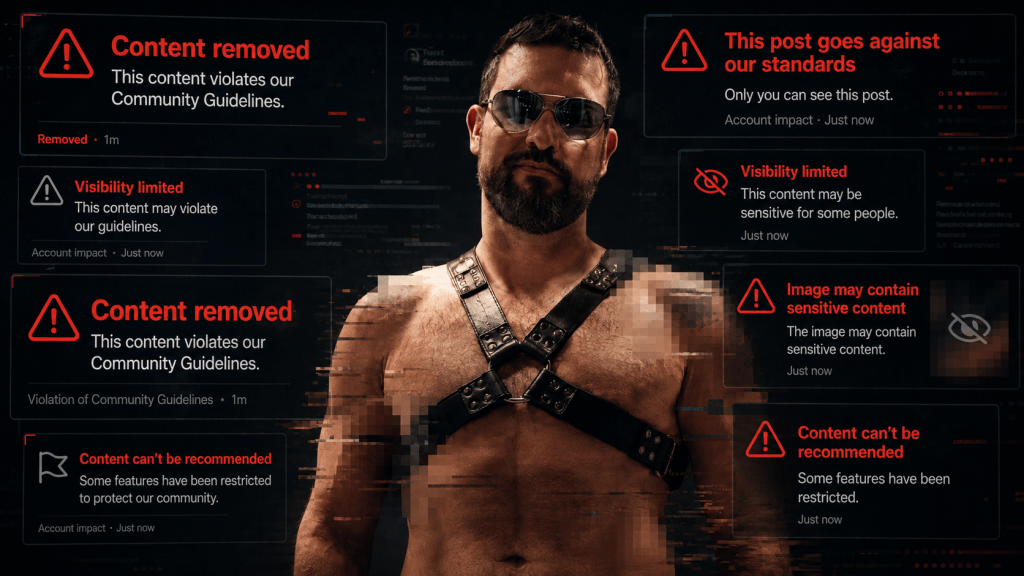
Russell T Davies’ Tip Toe imagines the erosion of LGBTQ rights as a slow social poisoning. For leathermen, trans people and anyone too visibly queer for polite society, the warning already feels close to home.
Russell T Davies has always understood something essential about queer life: danger rarely arrives honestly. It does not always announce itself with a raised fist or a shouted slur. Sometimes it comes with concern. Sometimes it comes with safeguarding language. Sometimes it comes dressed as “common sense”, parental rights, free speech, religious liberty or protection of children.
That is why Tip Toe, his Channel 4 drama about escalating hostility between a gay bar owner on Canal Street and his neighbour, matters. The series is not simply about individual prejudice. It is about atmosphere. It is about the social permission structure that allows prejudice to grow, harden and become respectable. Recent coverage has described the drama as focusing on rising intolerance and social division, with a brutal late-series act of violence presented not as a freak event, but as the consequence of repeated opportunities to look away.
That is the part that feels most familiar. LGBTQ rights are rarely dismantled in one dramatic parliamentary bonfire. They are chipped away through guidance, briefing notes, media panics, platform rules, school policies, funding decisions and a thousand small acts of institutional cowardice.
Britain’s LGBTQ+ Backlash Is Not an Accident. It Is Being Engineered
The enemies of progress do not always wear jackboots. In Britain, quite often, they wear suits and publish PDFs.
In recent years, a cluster of right-wing think tanks has moved from its traditional terrain of tax, deregulation and public sector reform into the moral politics of gender and sexuality. Policy Exchange, Civitas, the Institute of Economic Affairs and the Centre for Policy Studies are not merely observing the culture war. They are helping to write its script.
Policy Exchange has been especially influential in framing trans inclusion in schools and public services as a safeguarding crisis. Its work on gender and schools has argued that institutions have mishandled questions of gender identity and parental knowledge. That language sounds calm. It sounds bureaucratic. But its practical consequence is stark: the vulnerable child becomes a risk object, the supportive teacher becomes suspect, and the trans pupil is transformed from a young person needing care into a problem to be managed.
Civitas has gone further in its language, publishing material that frames “transgender ideology” as corrosive. The phrase itself does much of the work. It turns people into doctrine. It turns identity into contamination. It allows adults to talk about trans children without sounding as though they are talking about children at all.
The Institute of Economic Affairs takes a slightly different route. It tends to approach the same terrain through the language of classical liberalism. Free speech. Open debate. Resistance to compelled belief. These are important principles. But in the current climate, they are often deployed selectively. The freedom being defended is usually the freedom to misgender, exclude, mock or pathologise. The freedom less often defended is the freedom of LGBTQ people to move through public life without being treated as a debate topic.

The Centre for Policy Studies performs a quieter but still significant role. It provides a respectable stage on which “common sense” politics can be rehearsed. When Esther McVey used a CPS speech to attack civil service diversity initiatives, including rainbow lanyards and contracts with organisations such as Stonewall, it was a telling moment. A rainbow lanyard is a very small thing. That is precisely why the attack on it matters. The symbolic removal of LGBTQ visibility is often presented as neutrality, but neutrality has a habit of looking very much like disappearance.
The Polite Language of Disappearance
This is how regression works in modern Britain. Not always by saying “we hate gay people”. That would be too crude, too unfashionable, too revealing. Instead, the language shifts.
Visibility becomes “politicisation”.
Inclusion becomes “ideology”.
Pastoral care becomes “conversion”.
Diversity becomes “division”.
A leather harness becomes “adult content”, even when no sex is shown.
A trans teenager becomes a safeguarding incident.
A rainbow lanyard becomes a constitutional crisis.
This is where the drama of Tip Toe touches something deeper than television. Davies is interested in the social weather that makes violence possible. A country does not wake up one morning hostile. It is trained into hostility. It is nudged, primed, entertained and reassured.
And here the enemy is not only the think tank. It is also the feed.
When the Feed Becomes the Front Line
Meta is a revealing part of this story.
This is not theoretical for me. Eagle Manchester’s Instagram presence has already disappeared, another queer space made digitally invisible in an economy where visibility is survival. Closer to home, my own club, Newcastle Leathermen, has had to create “clean” backup accounts in case the original is sanitised by the AI algorithm. There is something bleakly absurd about that. A leather club preparing a respectable duplicate of itself, not because it has done anything wrong, but because an automated system may decide that queer leather culture is too adult, too risky, too visible or simply too inconvenient.
Like many large platforms, Meta performs a kind of corporate LGBTQ friendliness when it suits the season. Pride graphics. Rainbow branding. Carefully worded statements about belonging. Yet queer communities have repeatedly reported suppression, restriction and removal of content that is not conventionally palatable. In early 2025, Instagram acknowledged that LGBTQ-related hashtags, including terms such as gay, lesbian, trans and nonbinary, had been wrongly treated as sensitive content, restricting visibility for users, including teenagers whose settings limited such material by default.
That matters because visibility is not cosmetic. For many isolated LGBTQ young people, a search term is a lifeline. If “gay” or “trans” is treated as inherently sensitive, the platform is not protecting children. It is repeating the logic of Section 28 in algorithmic form.
There have also been wider concerns about Meta’s treatment of queer and reproductive health content. Campaigners have accused Meta of shutting down or restricting accounts connected to abortion access, queer advocacy and sex-positive health information, with affected groups describing opaque enforcement and poor appeal processes. Meta denies ideological bias, but the pattern is familiar enough to many queer users: harmful content often circulates freely, while marginalised communities are told that their existence has triggered a safety filter.
The Queer Lives Too Adult for Corporate Pride
For the leather community, this is not an abstract problem. Leather, kink and fetish culture sit at the edge of what corporate platforms are willing to tolerate. Not necessarily because the content is pornographic, but because it is unmistakably adult, embodied, queer and resistant to sanitisation.
Leather does not fit the version of LGBTQ identity that corporations prefer. It is not the smiling Pride advert. It is not the office diversity poster. It is not the harmless gay best friend. Leather carries history. It carries sex, grief, masculinity, play, ritual, chosen family, AIDS memory, bar culture, biker culture, working-class codes, military echoes, camp theatricality and erotic defiance. It says that queer liberation was never only about being accepted at the dinner table. It was also about building rooms of our own when the dinner table was denied to us.
That makes it threatening.
Not because leather is dangerous, but because it refuses respectability. It reminds the world that queer people did not survive by becoming acceptable. We survived by finding each other. We survived in bars, clubs, backrooms, bedrooms, helplines, marches, support groups and chosen families. We survived through community long before the state or the market decided we were safe enough to sponsor.
This is why the erasure of leather and fetish content online matters. When platforms flatten LGBTQ life into something clean, young, brand-safe and desexualised, they are not simply moderating content. They are curating which queer lives are allowed to be seen. The leatherman becomes too much. The older gay man becomes too complicated. The trans body becomes too contested. The kink community becomes too risky. The result is a digital Pride parade with the radical parts cropped out.
And that suits the enemies of progress perfectly.
Because respectability politics has always been one of the most effective tools of queer containment. The message is simple: you may be tolerated if you are quiet, tidy, monogamous, gender-conforming, professionally useful and preferably available for corporate branding. But do not become inconvenient. Do not wear the harness. Do not defend the trans teenager. Do not mention sex. Do not remind anyone that Pride began as a confrontation with police power, state neglect and social disgust.
How a Minority Becomes a Moral Panic
Social media is where moral panic learns to run. A think tank report becomes a headline. A headline becomes a clip. A clip becomes a pile-on. A pile-on becomes “public concern”. “Public concern” then becomes a ministerial priority. By the time actual LGBTQ people are asked how this feels, the machinery is already moving.
One observation from the trans community cuts through this very clearly. When gender-critical people are asked when and why they became so invested in trans issues, some give deeply personal answers: a loved one transitioned, a family relationship changed, something intimate and difficult happened close to home. That deserves a degree of understanding and curiosity. But another answer appears again and again: people feel that trans people have suddenly forced themselves into public life, that they are everywhere, unavoidable, in every newspaper, every policy debate, every argument online.
There is a truth buried in that perception, but not the truth the backlash imagines. Trans people have not forced themselves into the national conversation by sheer volume or power. They are a tiny minority, many of whom would much rather be left alone to live ordinary lives with access to healthcare, dignity and safety. What has exploded is not trans power, but trans coverage. The public is not being overwhelmed by trans people demanding attention. It is being overwhelmed by newspapers, politicians, lobbyists and think tanks endlessly debating them as a problem.

That distinction matters. If a small minority is subjected to relentless scrutiny, every incident becomes symbolic. Every protest, every individual mistake, every criminal case, every clumsy slogan can be inflated into evidence of a supposed systemic threat. But isolated incidents do not automatically justify system-wide restrictions. Human beings sometimes behave badly. Trans people are human beings, not saints, symbols or moral abstractions. The question is whether there is evidence of a population-level danger requiring population-level control. Much of the backlash proceeds as if that evidence already exists, when too often what exists is repetition, amplification and fear.
And if we think this machinery will stop with trans people, we are deluding ourselves: once queerness is made conditional for one of us, it becomes negotiable for all of us.
The Holy Language of Backlash
This is also where we need to speak more plainly about Christian nationalism and the Christian conservative lobby.
The UK is not America, and it is too easy to import American language lazily. But the ideological traffic is real. The “anti-gender” movement has been analysed internationally as closely related to right-wing populism, nationalism and the Christian right, particularly through narratives that frame equality for women and LGBTQ people as a threat to the traditional family.
In Britain, the Christian conservative lobby has often operated through the language of conscience, parental rights, religious liberty and opposition to conversion therapy bans. The Evangelical Alliance has warned against conversion therapy legislation on the grounds that it might criminalise church leaders or restrict religious freedom, while campaigners have warned that broad religious exemptions could leave LGBTQ people exposed to harmful practices under the guise of prayer or pastoral support.
Core Issues Trust is an even starker example. It has long been associated with efforts to change or suppress same-sex attraction, including the notorious “ex-gay” bus advert controversy in 2012 and later conversion-focused material. Conversion therapy is widely rejected by major medical and psychological bodies as harmful and ineffective, and UK professional bodies have committed to ending it.
The language has modernised, but the architecture is old. The old claim was that homosexuality was sinful, disordered or curable. The newer claim is that gender identity is ideology, that schools are corrupting children, that affirming care is conversion, that religious institutions must retain the freedom to guide people away from LGBTQ lives while calling it compassion.
This is not a side issue. It is central to the backlash. Think tanks provide policy language. Christian conservative groups provide moral language. The media provides amplification. Social media provides distribution. Politicians provide implementation.
Together, they create the conditions in which regression can pretend to be protection.
The great trick is that each part of the machine denies responsibility for the whole. The think tank says it is only asking questions. The lobby group says it is only defending conscience. The platform says it is only enforcing guidelines. The newspaper says it is only reporting concerns. The minister says they are only responding to public anxiety.
But the result is cumulative. A child feels less safe at school. A teacher becomes frightened to be kind. A civil servant removes a rainbow lanyard. A Pride event loses support. A trans person avoids healthcare. A leatherman stops posting photographs of community events. A young queer person searches for themselves online and finds a blank page.
That is how rights erode. Not always by repeal. Sometimes by shame.
What Progress Would Actually Look Like
The progressive alternative is not difficult to imagine. Left-leaning think tanks such as IPPR, the Fabian Society and the New Economics Foundation tend to understand LGBTQ rights as part of a wider social settlement: housing, health, safety, education, employment, dignity and community. That is the correct frame. LGBTQ rights are not a decorative add-on to politics. They are a test of whether a society means what it says about freedom.
A genuinely progressive agenda would defend inclusive education without apology. It would ban conversion practices without loopholes that allow harm to be relabelled as prayer. It would protect trans people without treating their existence as an administrative inconvenience. It would recognise that queer mental health is shaped by stigma, exclusion and minority stress. It would understand that leather bars, Pride marches, queer clubs and fetish communities are not embarrassing extras. They are part of the living infrastructure of LGBTQ survival.
And it would resist the corporate laundering of Pride. A rainbow logo in June means very little if the same platform suppresses queer search terms, removes non-explicit leather content, or allows LGBTQ people to be discussed as though their identities are pathological. Pride without protection is marketing. Inclusion without visibility is management. Tolerance without power is permission that can be withdrawn.
The Warning Was Never Fiction
That is the warning of Tip Toe. It is not simply that hatred exists. We know that. It is that hatred becomes dangerous when institutions translate it into respectable language.
The enemies of progress rarely say, “Let us make queer people afraid again.”
They say, “Let us restore balance.”
They say, “Let us protect children.”
They say, “Let us defend women.”
They say, “Let us respect religious freedom.”
They say, “Let us avoid political symbols.”
They say, “Let us apply community guidelines.”
And before long, the queer world is smaller.
Why Leathermen Should Pay Attention
For leathermen, this should be particularly clear. Our culture was never built for comfort. It was built in defiance of shame. It was built by men who understood that masculinity could be reclaimed, eroticised, exaggerated, parodied and shared. It was built by communities that knew the value of coded recognition: the boots, the bars, the patches, the uniforms, the glances, the rituals. It was built in the shadow of police hostility, AIDS grief, family rejection and public disgust.
That history gives us a responsibility. We should be suspicious whenever power tells us that visibility is the problem. We should be wary when queerness is accepted only after it has been stripped of sex, risk, age, kink, transness, anger and memory. We should remember that every generation is offered a bargain: be respectable, and perhaps they will spare you.
But they never spare everyone.
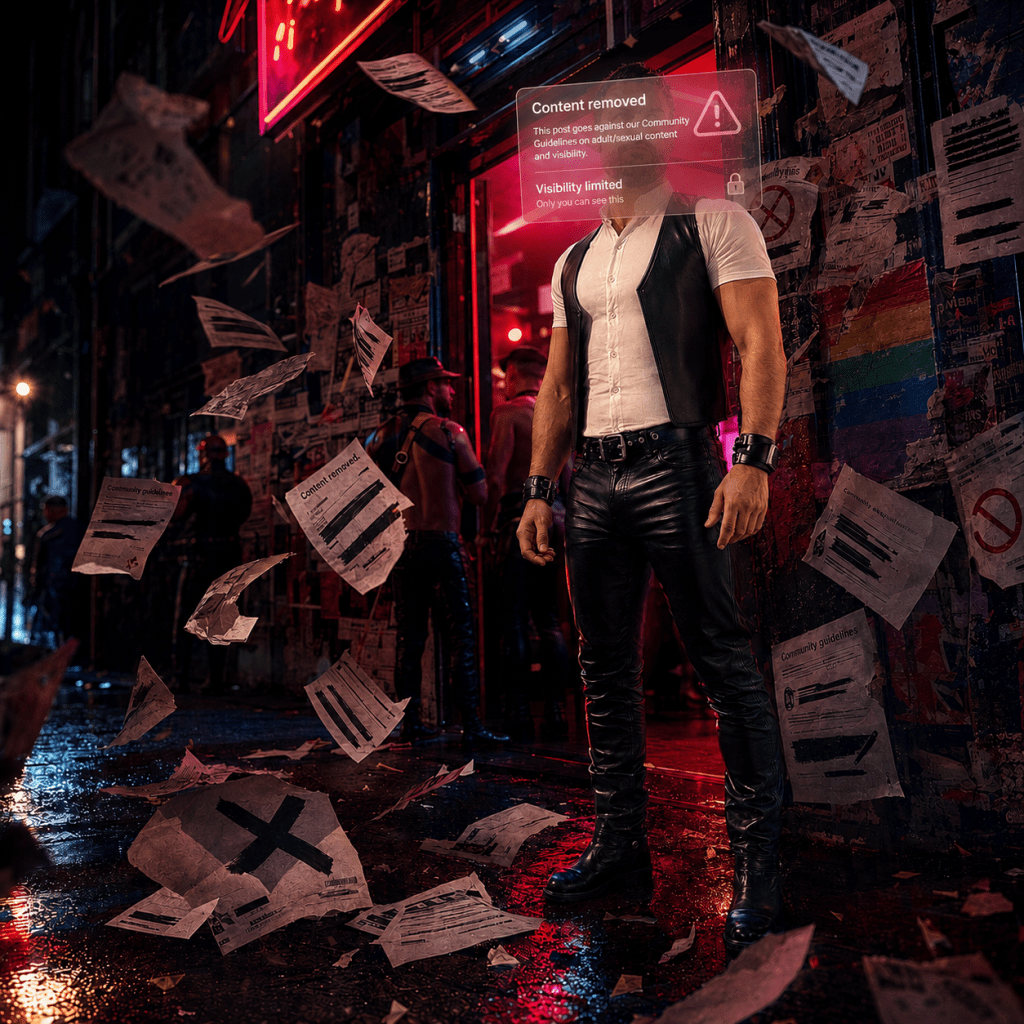
First they come for the trans people. Then for the drag queens. Then for the lanyards. Then for the books. Then for the teachers. Then for the leather. Then, for the memory of how any of us survived.
Name the Machine
So yes, name the enemies of progress. Name the think tanks. Name the lobby groups. Name the social media platforms. Name the politicians who turn fear into policy and call it common sense.
But also name what they fear.
They fear the queer child who finds language.
They fear the trans adult who refuses disappearance.
They fear the leatherman who will not apologise for being visible.
They fear the old gay man who remembers.
They fear the community that knows its history.
They fear us most when we stop asking permission.
 BlufBear
Leave a comment