
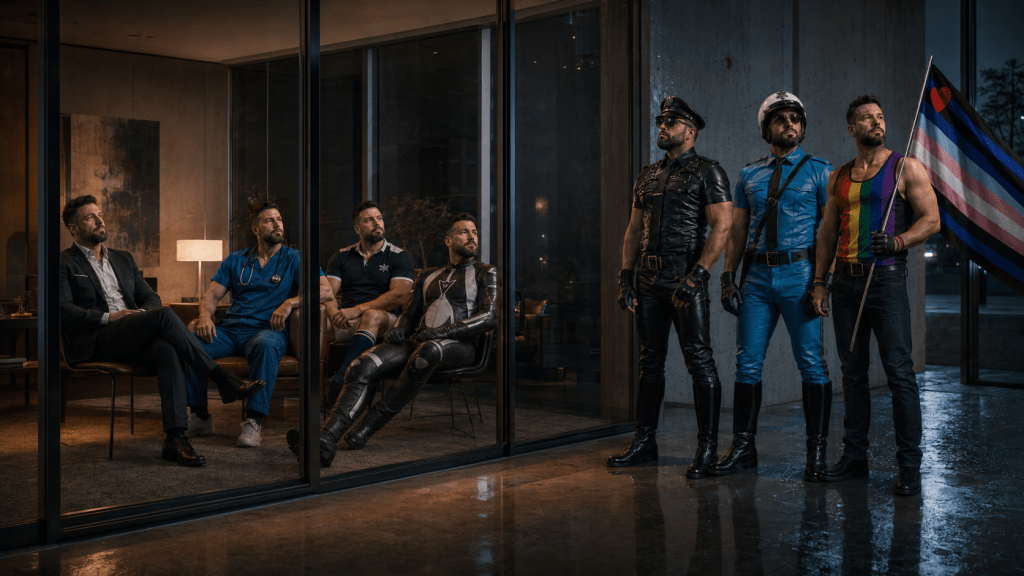
Every few days now, I seem to read another post from a gay man explaining why he no longer supports Pride.
It has become too political. Too trans. Too activist. Too vulgar. Too full of drag queens, kinksters, flags, pronouns, shouting, spectacle and shameful excess. It no longer represents people like him, he says. He is just a normal gay man who wants to get on with his life.
And somewhere beneath all that, sometimes stated plainly and sometimes only implied, sits the word that does the real work.
Freaks.
I read these posts with a mixture of anger, recognition and sadness. Anger, because the language is so familiar. Recognition, because I know exactly where it comes from. Sadness, because I think many of these men are not as free as they believe themselves to be.
I suppose I am one of those freaks.
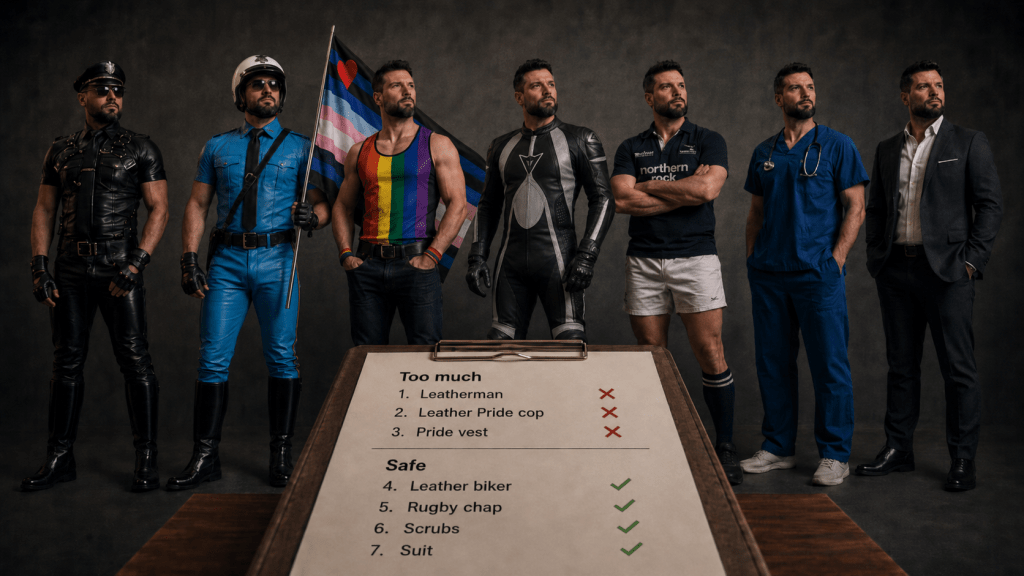
I am a gay man in my mid-40s. I write as BlufBear. I am a leatherman. I march in boots and leather. I have written about shame, desire, BDSM, mental health, visibility and the strange psychological bargains that queer people make with the world in order to survive it. There was a time when I would not have been able to do any of that. There was a time when the sight of someone too visible, too camp, too sexual, too gender non-conforming, would have stirred something defensive in me.
Not hatred, exactly.
Fear.
Fear that if I stood too close, people would think I was one of them. Fear that their visibility would expose me. Fear that their refusal to hide would undo all the work I had done to appear acceptable.
That, I think, is the part we do not talk about enough.
We are very good at discussing homophobia when it comes from outside the community. We are less comfortable discussing the version that survives inside us, wearing the clothes of common sense, respectability and political realism. We do not always recognise it because it rarely speaks in the old language. It does not always say, “I hate gay people.” Sometimes it says, “I just don’t want Pride shoved in people’s faces.” Sometimes it says, “Why does everything have to be about trans people?” Sometimes it says, “We had equality until the activists ruined it.” Sometimes it says, “I’m gay, but I’m not one of those gays.”
I know that sentence because some version of it once lived in me.
For men of my generation, visibility was not something we were born into. It was something we approached cautiously, if at all. We grew up in the long shadow of Section 28, AIDS panic and tabloid disgust. We heard words like poof, bender, queer and pervert long before we had the emotional tools to understand why they hurt. We learned that gayness was either a joke, a threat, a tragedy or a pathology. It was the camp shop assistant, the predatory older man, the lonely bachelor, the dying patient, the dangerous outsider.
In school, people like us did not exist, except as insult. At home, if homosexuality was mentioned at all, it was often accompanied by pity, disgust or warning. In the wider culture, the message was unmistakable: whatever you are, do not let it show.
So we learned.
We learned to lower the voice, alter the walk, police the hands, watch the clothes, manage the laugh. We learned which boys were safe to admire and which boys were dangerous to desire. We learned that being perceived could be fatal, socially if not physically. We became students of the room. We monitored ourselves before others could do it for us.
That is not simply caution. It is training.
The psychiatrist in me thinks of minority stress. The writer in me thinks of the panopticon, that internalised watchtower from which we learn to observe ourselves through the eyes of those who might punish us. The gay boy in me remembers the bodily sensation of it: the jolt of being noticed, the heat in the face, the sudden calculation of whether one has given too much away.
When you grow up like that, survival can look like masculinity.
Not the generous kind of masculinity, not the grounded, tender, self-possessed kind, but the brittle sort built from denial. The kind that says: I am not weak. I am not camp. I am not like them. I am acceptable. I am normal. I am safe.
This is the good boy’s bargain.
Behave properly and perhaps they will let you in. Dress correctly and perhaps they will stop laughing. Distance yourself from the embarrassing ones and perhaps they will mistake you for respectable. Find the group currently receiving society’s contempt and quietly step away from them. Better still, join the chorus. Prove that you understand the rules. Prove that you are not the problem.
The target changes with the decade.
Once it was drag queens. Then leathermen. Then men with HIV. Then the camp boys, the femme boys, the rent boys, the activists, the ones who would not assimilate. Today, very often, it is trans people.
The mechanism remains the same.
I do not write that as an accusation from above. I write it because I recognise the mechanism in myself. When I was younger, I wanted desperately to be seen as one of the acceptable ones. I wanted people to know I liked motorcycles, science fiction, leather jackets and masculine things. I wanted gayness to be only one quiet fact among many, preferably a fact that did not disturb anyone. I was not yet able to see how much of that desire was shaped by shame.
Shame is clever. It rarely announces itself as shame. It presents itself as taste. Prudence. Realism. Preference. Concern about optics. It says, “I’m not ashamed, I just think Pride has gone too far.” It says, “I have nothing against trans people, but.” It says, “I support equality, but why do they have to make such a spectacle of themselves?”
And because these arguments often contain fragments of reasonable concern, they become harder to challenge. Of course Pride can be messy. Of course activist politics can be clumsy. Of course no community is above critique. But criticism becomes something else when it is built around disgust at those whose visibility threatens our own fragile accommodation with the world.
The question is not whether Pride should ever be criticised. It should. The question is why some gay men appear so eager to repeat the exact grammar once used against them.
Too loud. Too sexual. Too political. Too visible. Bad for children. Bad for public acceptance.
Bad for people like us.
There is a deep irony in seeing gay men, whose own freedoms were won by those willing to be unpopular, now scolding others for making the movement untidy. The freedoms many of us enjoy were not handed down because polite homosexuals asked nicely. They were fought for by coalitions of the marginalised: lesbians, gay men, bisexuals, trans people, drag queens, leathermen, sex workers, trade unionists, feminists, people with HIV, carers, nurses, radicals and ordinary frightened people who eventually became too tired to disappear.
Those people were called freaks too.
That word has always done political work. It creates distance. It separates the acceptable minority from the disposable one. It reassures the speaker that they are not really implicated. “I may be gay,” it says, “but at least I am not that.”
This is where the current flirtation between some gay men and Trumpian/ReformUK-style politics becomes so revealing. I do not think every gay man drawn to the populist right is secretly motivated by shame. People vote for all sorts of reasons: immigration, taxation, distrust of Westminster, anger at Labour, exhaustion with institutions, cultural dislocation, a feeling that no one listens. It would be intellectually lazy to reduce all of that to internalised homophobia.
But it would be equally lazy to ignore the emotional charge.
For some gay men, politics that promises order, borders, discipline and a return to common sense can feel strangely comforting. If your early life taught you that safety comes from fitting in, then a movement built around belonging to the sensible majority may have obvious appeal. If you spent years trying to prove you were not one of the embarrassing ones, then a party that sneers at “woke” excess may feel like it is finally saying aloud what you learned to whisper internally.
The seduction is not just ideological. It is psychological.
Reactionary politics offers the good boy a reward. It tells him he can keep his place at the table if he helps identify who should be removed from it. It allows him to feel strong after years of feeling vulnerable. It offers him the intoxicating possibility of joining the judging class rather than remaining among the judged.
But history should make queer people wary of bargains with those who tolerate us only when we are useful.
The populist right has no deep investment in gay liberation. At best, it may find certain gay men convenient, particularly those willing to join attacks on migrants, Muslims, trans people or “woke” institutions. But convenience is not solidarity. Conditional inclusion is not safety. A politics that builds itself by marking out internal enemies will not stop at the first border it draws.
And perhaps this is the hardest lesson: you cannot secure your own dignity by helping to strip it from someone else.
I have had to learn that slowly.
Leather helped me, though not in the way outsiders might imagine. People often see leather as performance, costume, sex, dominance, provocation. It can be all of those things. But for me, it has also been a school of honesty. It taught me that masculinity does not have to be the denial of vulnerability. It can be deliberate, embodied, playful, erotic, disciplined and tender. It taught me that power is most meaningful when it is negotiated, not assumed. It taught me that visibility, once terrifying, can become a form of integrity.
I have worn many costumes in order to survive. Some were literal, some were psychological. The suit, the scrubs, the rugby shirt, the biker leathers: each has allowed me to move through the world with a certain kind of permission. They are not false selves. The doctor is real. The professional is real. The man who finds comfort in masculine clothing, motorcycles, boots and structure is real too. But so is the leatherman. So is the Pride vest. So is the man who no longer wants to edit himself into acceptability before leaving the house.
The problem was never that I had different selves. The problem was the hierarchy I was taught to place them in. Some parts of me were allowed to be visible because they reassured other people: competent, masculine, useful, respectable. Other parts were treated as dangerous because they revealed too much: desire, colour, queerness, defiance, tenderness, joy. Healing, for me, has not meant choosing one version and discarding the rest. It has meant refusing the old checklist. I do not want only the safe versions of me to be seen. I want all of them in the room. I am not here to be edited down to the version of myself that makes other people comfortable.
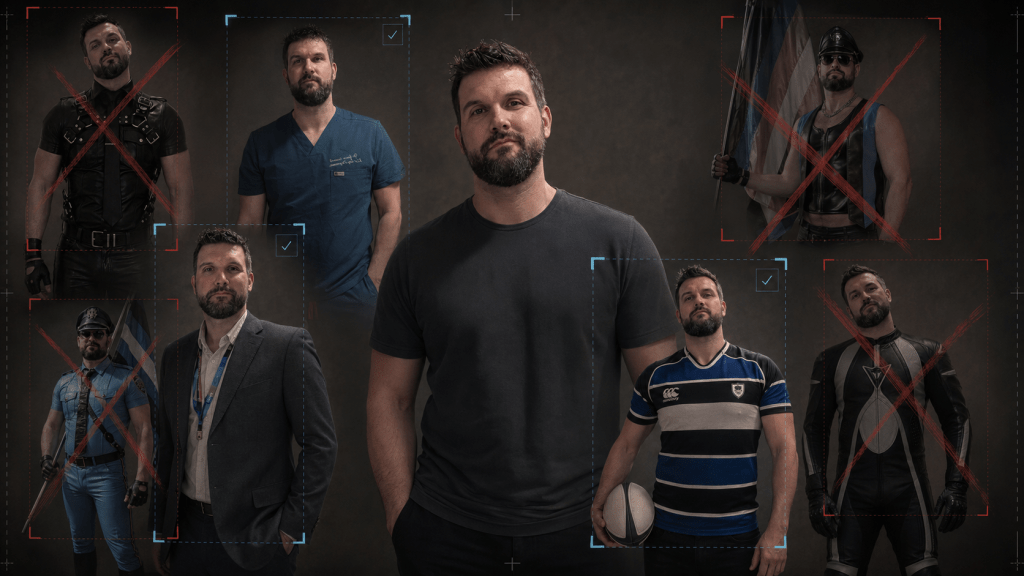
When I stand at Pride in leather, I am not asking everyone to understand me. I am not asking every passer-by to approve of my boots, my cap, my body, my symbols or my desires. I am doing something much simpler and much harder.
I am refusing to let shame decide where I am allowed to stand.
That is why the contempt directed at “freaks” lands so heavily. It is not merely an aesthetic disagreement. It is a demand that some of us return to the margins so others can feel less exposed. It says: your visibility makes my acceptance more difficult. It says: your freedom threatens the fragile deal I made with respectability.
But the problem is not the leatherman, the drag queen, the trans teenager, the activist with a placard or the non-binary person with blue hair. The problem is the bargain itself.
Because respectability is a moving target. You can spend your whole life chasing it and still find, at the end, that someone else has decided you are the embarrassment. You can do everything right, marry, pay the mortgage, avoid the scene, keep your sexuality discreet, laugh at the right jokes, distance yourself from the right people, and still be reminded by the wrong politician, columnist or drunk man in the street that your acceptance was provisional.
Many of us know this already. We know it in the body. We know it in the way we tense when a group of rowdy men passes too close. We know it in the careful calculation before holding a partner’s hand. We know it in the memory of school corridors, family silences and newspaper headlines. We know it in the old reflex to shrink.
That reflex does not vanish just because the law changes.
Marriage equality did not cure shame. Corporate Pride did not cure shame. Being able to say “my husband” in polite company did not cure shame. These things matter, enormously. But they do not automatically undo the psychic architecture built in childhood.
And so some men grow older carrying a contradiction. They have legal rights, perhaps social status, perhaps money, marriage, professional standing and outward confidence. Yet somewhere inside remains the frightened boy scanning the room for danger. If he has not learned to recognise that fear, he may misread it. He may think the danger comes from the most visible queer person nearby, rather than from the society that taught him visibility was dangerous in the first place.
That is why I do not want simply to condemn the men making these posts, though sometimes I am tempted. I want to ask what wound is speaking through them.
Who taught you that your safety depended on someone else being less visible?
Who taught you that dignity meant distance from the marginalised?
Who taught you that Pride was acceptable only when it looked like a bank advert, a wedding photo or a polite diversity brochure?
Who taught you to fear the freak?
And what would happen if you recognised him as kin?
This is not a plea for every gay man to love Pride uncritically. It is not a demand that everyone become an activist, wear leather, wave every flag or agree with every slogan. Community does not require uniformity. Solidarity does not mean the absence of disagreement.
But solidarity does require memory.
It requires us to remember that our own respectability did not save us. Other people’s courage did. It requires us to remember that the line between “normal” and “freak” has always been drawn by those with power, and rarely in our favour. It requires us to ask whether our discomfort is moral clarity or merely old shame finding a new vocabulary.
The opposite of shame is not pride, not exactly.
Pride can be a parade, a protest, a party, a brand, a battleground, a weekend, a flag. It can be glorious and irritating, moving and chaotic, commercially compromised and politically necessary, all at once.
The opposite of shame is solidarity.
Shame teaches us to survive by creating distance from those judged more harshly than ourselves. Solidarity asks us to close that distance. Shame says, “At least I am not one of them.” Solidarity says, “I know why you were taught to fear them. Go and stand beside them anyway.”
That is the journey I am still on.
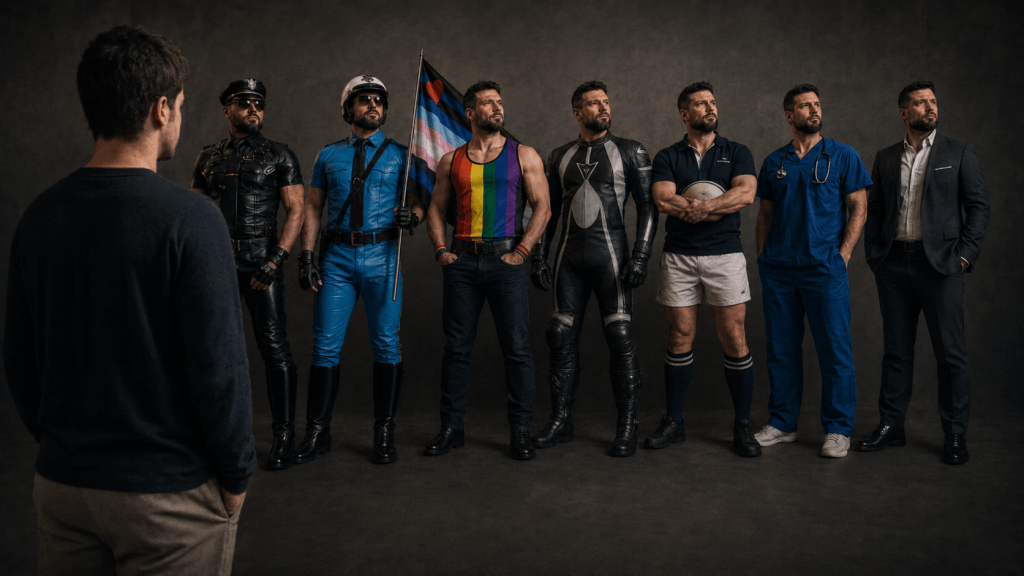
From the boy who did not want to be noticed, to the man who wears leather in public. From the young gay man who wanted to be acceptable, to the older one who understands that acceptance without authenticity is only another closet. From the good boy trying to earn safety, to the freak who finally stopped asking permission.
And if Pride still matters, perhaps it is because it offers that possibility to all of us.
Not just the right to be tolerated.
The courage to be seen.
And the grace to recognise ourselves in those we were taught to avoid.

Leave a comment