
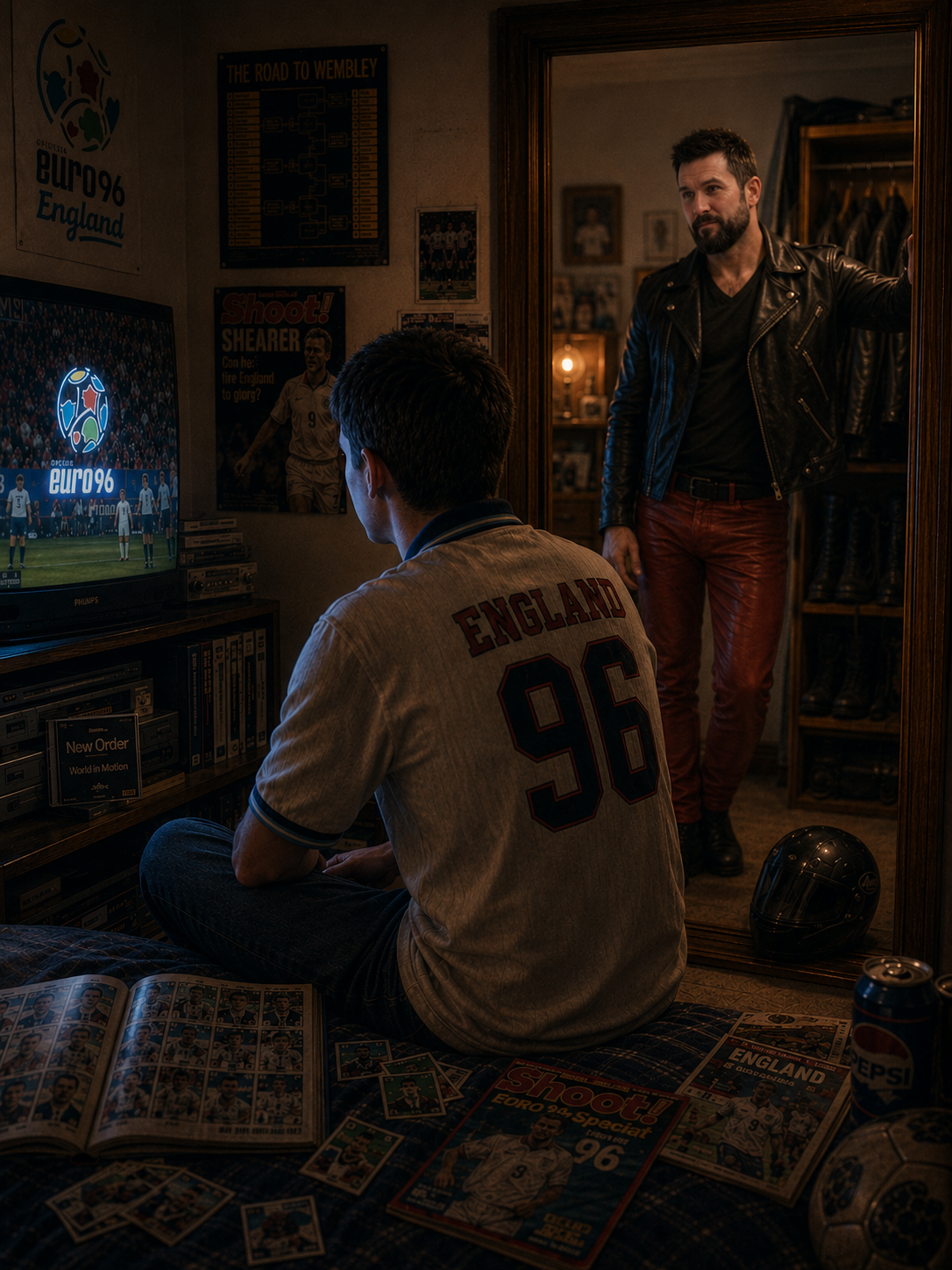
Football taught me how to fit in. Leather taught me I never had to.
There are certain songs that can transport you to another version of yourself in an instant.
For me, one of them is World in Motion. New Order’s anthem for the 1990 World Cup still carries the smell of long summer evenings, wall charts pinned to bedroom doors, sticker albums spread across the carpet, and the anticipation that only a major international tournament can bring.
By the time USA ’94 arrived, and then Euro ’96, football had become more than a game.
Without really understanding it, I had entered another competition altogether.
Like many gay boys growing up under the shadow of Section 28, I was learning that belonging often depended upon how convincingly you could perform normality. Football became part of that performance. I genuinely loved the tournaments. I still love the World Cup and the Euros today. I loved the drama, the stories, the hope that England might finally do it this time, and the strange national ritual of grieving together when we inevitably fell just short.
But somewhere underneath that genuine enjoyment was another motivation.
Football was safe.
It offered a script.
If everyone else was talking about Alan Shearer or Gazza, so was I. If everyone else cared about England’s next match, then so did I. Every conversation I could join without anyone wondering about the conversations I desperately wanted to have instead felt like another layer of camouflage.
I wasn’t pretending to enjoy football.
I was pretending that football was the whole story.
Thirty years later, football looks very different.

Rainbow laces. LGBTQ+ supporters’ groups. Pride campaigns. Clubs speaking openly about inclusion. Progress that would have been difficult to imagine when I was a teenager.
Which is why I found myself reflecting on FIFA’s so-called Pride Match.
Seattle has designated the World Cup fixture between Iran and Egypt as its Pride Match. FIFA, meanwhile, has reportedly been keen to describe it as a local initiative rather than an official tournament designation, while campaigners such as Peter Tatchell have questioned why FIFA appears more comfortable with symbolic inclusion than confronting the realities faced by LGBTQ+ people represented by some competing nations.
At first glance, the whole thing feels absurd.
A Pride Match involving two countries where LGBTQ+ people still face profound legal and social discrimination almost sounds like satire.
But the more I thought about it, the less interested I became in the fixture itself.
Instead, I found myself thinking about belonging.
Looking back, football wasn’t the only identity I tried on.
As I grew older, I drifted away from the week-to-week game. The international tournaments stayed with me because they had become woven into the rhythm of my life, but the rest slowly faded.
For a while, rugby took its place.
Again, I genuinely enjoyed it. I loved the physicality, the camaraderie and the challenge. Then I broke my back, and practicality brought that chapter to an abrupt end.
Yet even before the injury, something had already begun to trouble me. I realised I wasn’t simply playing rugby. I was auditioning for another version of masculinity.
Not lying exactly. Just editing. Keeping the parts of myself that seemed acceptable while quietly hiding the rest.
People sometimes imagine leather culture is about clothing.
They couldn’t be more wrong.
For me, it became something infinitely more valuable.
The motorcycle didn’t introduce me to leather. If I’m honest, leather had always been there.
Long before I owned a bike, there was something about it that fascinated me, but it felt like another part of myself that needed a justification. A leather jacket without a motorcycle invited questions; a leather jacket with one simply looked practical.
For years, that was enough. Leather became something I wore on the bike, or at the occasional fetish night, carefully compartmentalised from the rest of my life. It was another identity that existed within clear boundaries.
What changed wasn’t the motorcycle itself. It was watching people like Cal Rider champion the idea of Gear 365. Suddenly, leather wasn’t only for riding, or for clubs, or for nights when permission had already been granted. It could simply be clothing. It could be every day.

That shift gave me permission to stop explaining myself.
I wasn’t dressing as a motorcyclist.
I wasn’t dressing for a fetish event.
I was dressing as me.
And through that, I found something infinitely more valuable than an aesthetic.
Community.
Bears, bikers and leathermen who taught me, often without realising it, that authenticity is far more attractive than performance. Men who cared far less about whether I fitted somebody else’s definition of masculinity than whether I turned up as myself.
I had spent years trying to earn belonging.
Eventually I found a community that simply offered it.
That is why this story about FIFA has lingered in my mind.
Pride was never supposed to be another colourful marketing campaign attached to a sporting event. It began as a refusal to disappear. A declaration that nobody should have to edit themselves in order to participate in public life.
As a frightened teenager watching football in the 1990s, I couldn’t have articulated any of this. I simply knew that blending in felt safer than standing out.
Today I understand something I didn’t then.
Belonging isn’t something you achieve by becoming more acceptable.
It is something you discover when you stop negotiating away the parts of yourself that make you different.
Perhaps that’s the real lesson I’ve taken from football, from rugby, from motorcycling, from leather, and from every community that has shaped me along the way.
Not every version of ourselves deserves to survive.
Some are simply armour we built because we thought we had to.
The boy who sang along to World in Motion wanted to be loved because he looked like everyone else.
The man writing this has finally learned something far more important.
Love really can get the world in motion.
But it begins with learning to move towards yourself.
If BlufBear has a purpose, perhaps it is simply this: to help make that journey a little shorter for someone else.

Leave a Reply